
Features
It gathers parcels, activities, treatments, harvests, and lots into a coherent operational register.
- Vineyard and parcel records
- Activity log and user-entered products
- Connected harvest, lots, and bottling
Vineyard · Product
From row to cellar, without losing the thread.
 Link in preparation
 Link in preparation
Product
Vinetum follows the operational path from vineyard to harvest and light cellar work, keeping plots, activities, harvests, and lots connected.
It is designed for mobile field work and to remain useful even when the connection in the field is unreliable.
Inside the app
Real app screens, updated as the product evolves.
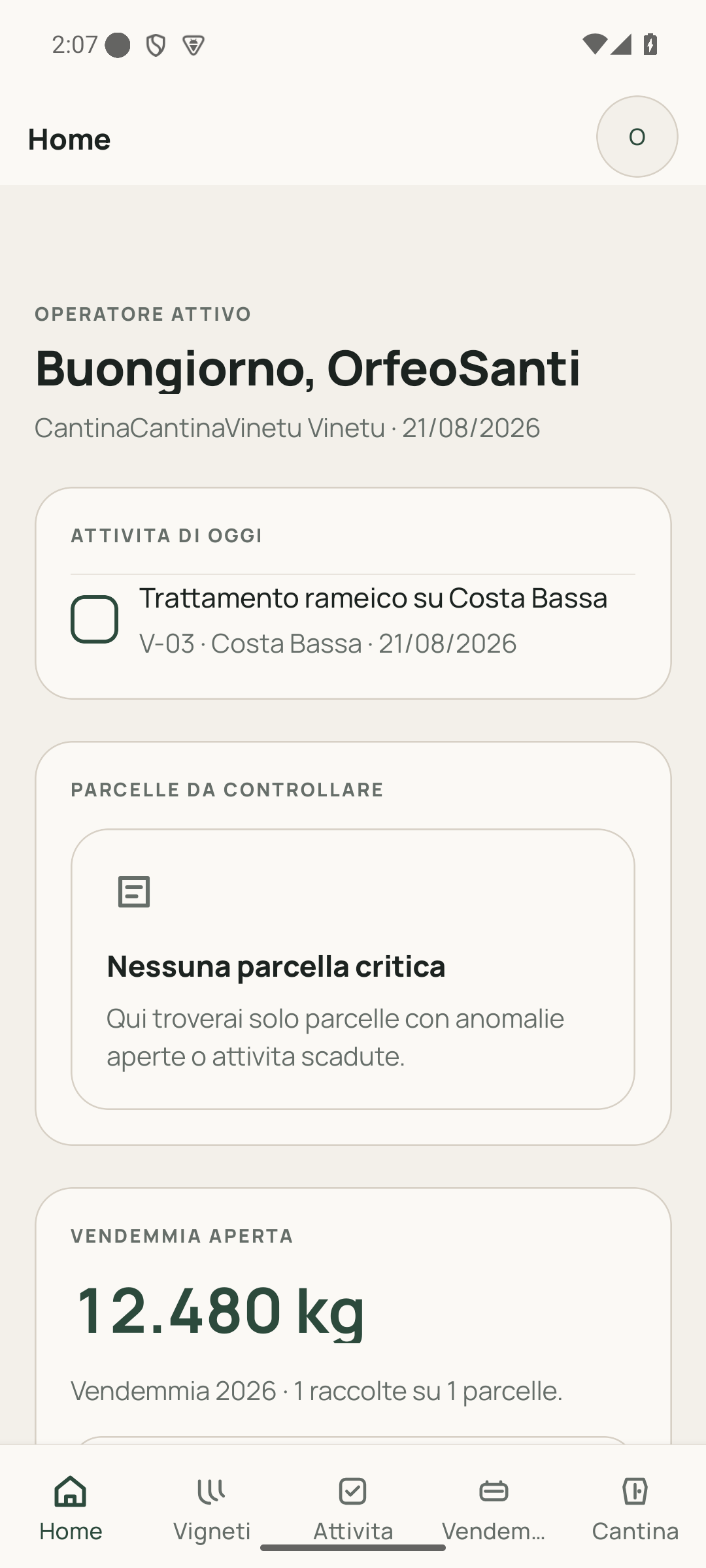
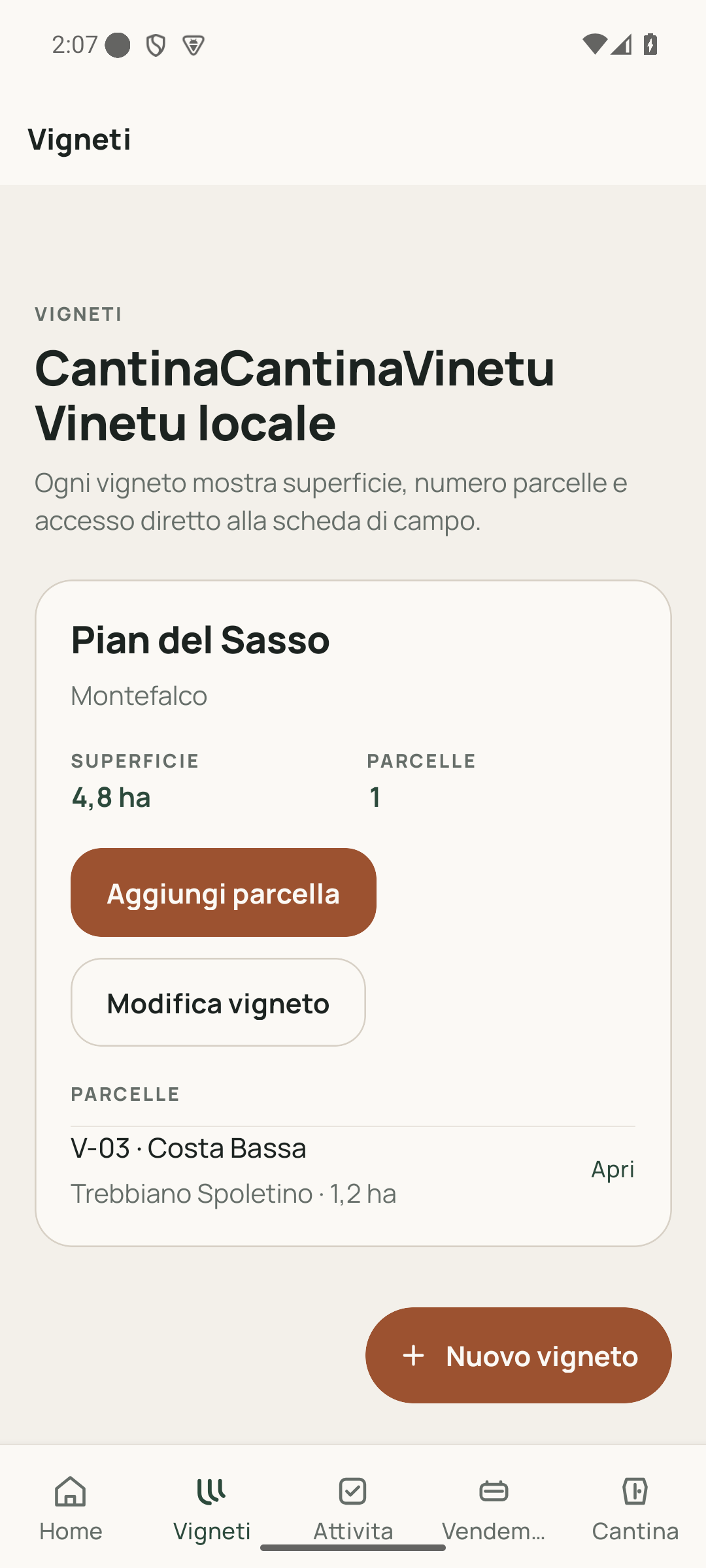
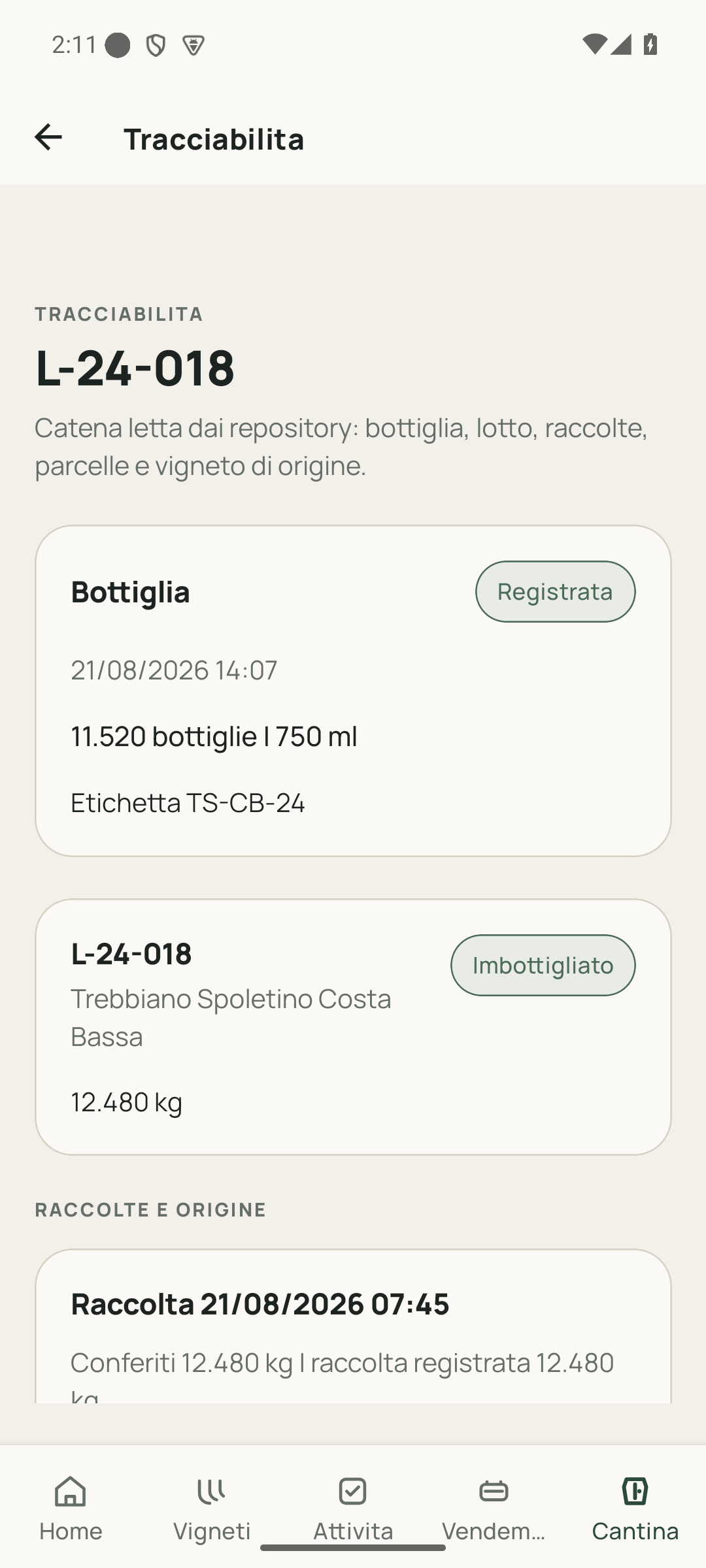
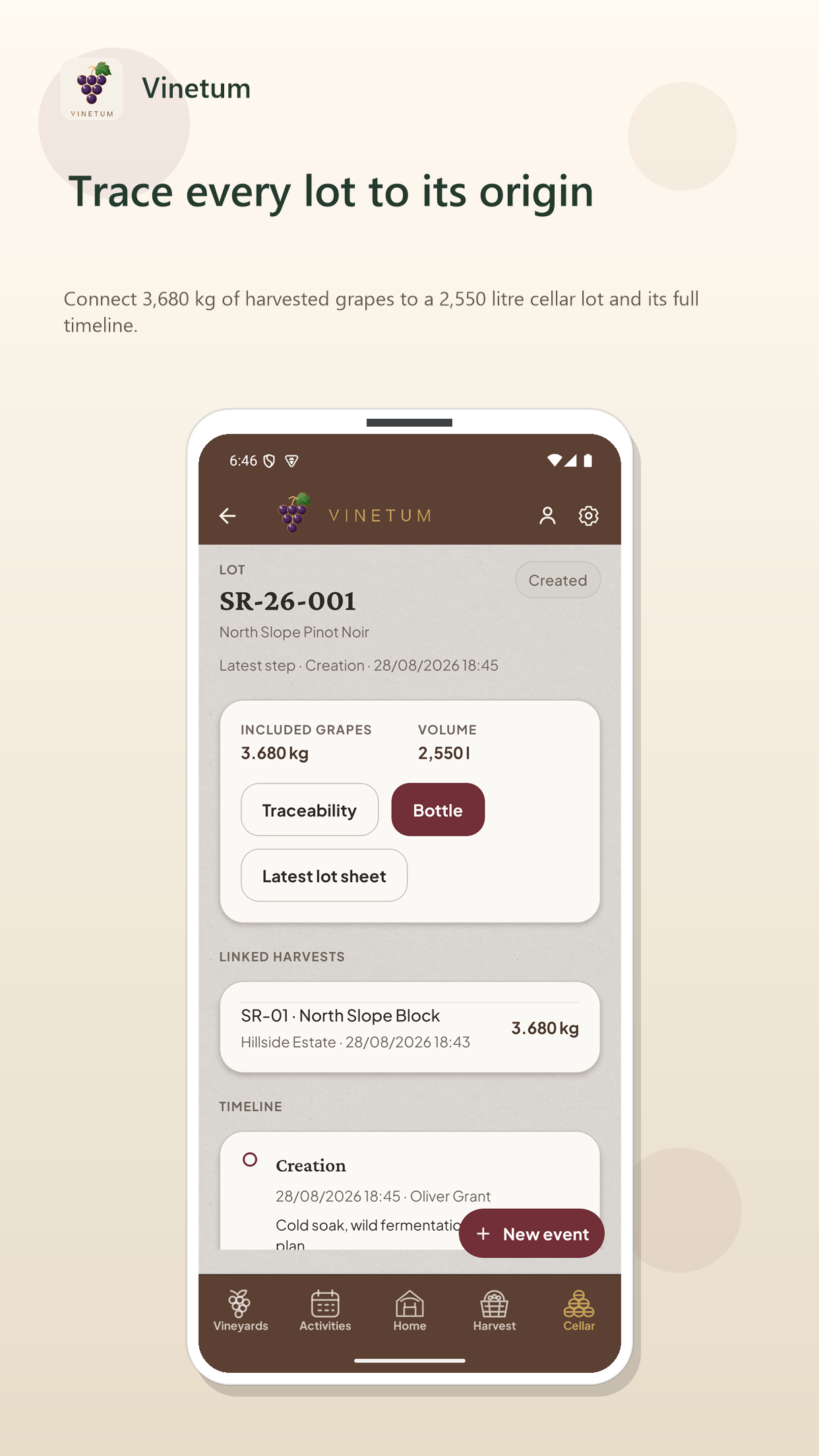
Vinetum follows mobile vineyard work through harvest and light cellar workflows, keeping operational data and decisions connected.
What it actually includes
Vinetum is a mobile operational log for wine-growing businesses: it manages vineyards, plots, workers, treatments, products, pre-harvest and re-entry intervals, phenology, harvest campaigns, yields, lots, cellar events, bottling, traceability, and PDF/CSV export.
Key features
It gathers parcels, activities, treatments, harvests, and lots into a coherent operational register.
It is designed to stay useful in the field and return ordered data when it needs to be shared.
It preserves continuity between vineyard work, harvest, and cellar without losing important steps.
Vinetum
The topics this app helps you manage every day.
A complete pesticide/spray record generally needs: date and time of application, product name, its official registration number, the target pest or disease, the block or plot treated, and both the pre-harvest interval (PHI) and re-entry interval (REI) tied to that product, since these countdown clocks start the moment you spray. Weather conditions and applicator name are commonly expected too, and most jurisdictions want records retrievable quickly if an inspector asks. Keeping this consistent across every plot and season is what makes a record useful rather than just paperwork. Vinetum lets you log each treatment against a plot with the product's registration number, target pest, PHI, and REI attached, so the operational history lives in one place - though it records data for your own use and does not replace your official regulatory record-keeping system or a professional consultant's sign-off.
Retention rules vary by country and by certification: general worker-safety frameworks often require two years, some regional pesticide authorities require three, and organic certification can require five years or more. Because thresholds differ by jurisdiction, the safest approach is to check with your local agricultural authority or certifier rather than assume one number applies everywhere. Vinetum's activity log keeps every treatment attached to its plot indefinitely and lets you export the history as PDF or CSV whenever you need to hand it over - but it is an operational log, not a substitute for the official regulatory record-keeping system your authority requires you to maintain.
In many regions, yes - most agricultural authorities now accept digital records as long as they are complete, legible, and can be produced quickly on request, but the exact acceptance criteria (format, retention, signatures) depend on your country's regulation, so confirm with your local authority or advisor before relying on any single tool. What matters more than the medium is that the data is accurate and accessible. Vinetum's offline-first activity log records treatments, dates, and plot-level details even without signal, and you can export them as PDF or CSV - but it is a working operational log for your own business, not itself the official regulatory record-keeping system, so keep it alongside whatever official register your jurisdiction requires.
The pre-harvest interval (PHI) is the minimum time that must pass between a treatment and harvesting the crop, so residues can decline to accepted levels. The re-entry interval (REI) is the minimum time workers must stay out of the treated block afterward, protecting people rather than the fruit - REIs are usually much shorter, often hours, while PHIs can run days to weeks. Both numbers come from the product label, not a general rule of thumb, so they need to be checked per product. Vinetum lets you enter the PHI and REI for each plant-protection product you use, attached to the treatment record for that plot, so both countdown dates sit alongside your other operational data - always confirm the exact figures on the product label or with a professional advisor, since Vinetum does not set or verify these values itself.
Most small growers end up juggling a paper notebook for treatments, a separate list for canopy work, and a mental note for irrigation - which is exactly where details get lost between seasons. Grouping every field operation (spraying, pruning, tying, leaf removal, topping, irrigation, fertilization) under the same plot-level timeline makes it far easier to see what was actually done and when, especially when comparing plots or years. Vinetum's activity log covers all of these operation types against each plot, so a season's work is reconstructed in one scrollable history instead of several disconnected records.
Yes, and it is worth doing - fertilization and irrigation timing often interact with disease pressure (a heavy nitrogen application before a wet spell can push vigorous, disease-prone growth), so keeping them in the same log as your treatments helps you spot those patterns later. Separate logs for each activity type make this kind of correlation much harder to see. Vinetum's activity log records irrigation and fertilization events alongside treatments and canopy work on the same per-plot timeline.
Field observations - a patch of chlorotic vines, an unexplained wilt, a mildew hotspot - are only useful if they're captured at the moment you see them and tied to the exact plot, since memory fades fast and 'somewhere near the third row' isn't precise enough weeks later. A quick note in the field, even offline, beats a mental reminder to write it up later. Vinetum's activity log includes an anomaly entry type so you can record what you observed against the specific plot on the spot, even without signal.
Look for 'oil spot' lesions - pale yellow to translucent, faintly greasy-looking patches on the upper side of young leaves - and, on humid mornings, check the underside of those same spots for a white, downy, cotton-like growth; that fuzzy underside sporulation is the clearest confirming sign. As it progresses, spot centers can dry and brown, shoots and clusters can show white down under wet conditions, and infected berries turn a dull mottled color and drop easily. Wet, humid weather after rain is when to check most carefully. Vinetum's observed phenology and plot notes let you record what you see, when, and on which plot, and compare it against the same plot in previous seasons to see whether pressure is trending earlier or worse.
Early signs are light chlorotic (yellowish) spots on the upper leaf surface, followed by a white to grayish, powdery or dusty coating that can appear on either leaf surface, shoots, and even berries - it genuinely looks and feels like a dusting of flour. Unlike downy mildew, it doesn't need free water on the leaf to develop and tends to favor warm, humid but not necessarily rainy conditions. Left unchecked it can scar berries and stunt shoot growth. Vinetum lets you log these observations by plot and compare the timing and severity to previous seasons, so you can see whether your canopy management or spray timing needs to shift earlier.
Downy mildew produces oily-looking yellow spots on top of the leaf and fuzzy white growth underneath, and it needs moisture (rain, dew, humidity) to spread. Powdery mildew produces a flour-like white-gray coating that can appear on both leaf surfaces without needing free water, and actually spreads more in dry, humid, shaded conditions. Because their triggers differ, a wet season can favor one and a dry-but-humid one can favor the other, so tracking which one shows up when, on which plot, tells you a lot about your local microclimate. Vinetum's plot-level activity log and phenology notes let you record which disease appeared, where, and compare that history year over year.
Timing should follow the vine's growth stage rather than a fixed calendar date - key trigger points are typically bud break for the first protective treatment, and again as shoots reach a few inches with rain in the forecast, since young, expanding tissue is most vulnerable to downy mildew infection. A cold spring can push the first spray back weeks compared to a warm one, so relying on last year's date alone can leave you unprotected or spraying too early. Vinetum's phenology tracking records when each stage (bud break, flowering, veraison, etc.) actually occurred on each plot, year over year, so you can see your own site's pattern instead of guessing from a generic regional calendar.
Downy mildew thrives on rain, dew, and warm humid nights - infections often follow measurable rainfall once températures are warm enough. Powdery mildew, in contrast, can build up in warm, humid but relatively dry, shaded canopy conditions, and doesn't need leaf wetness to spread. That's why two vineyards a few kilometers apart, or two blocks with different exposure, can have completely different disease pressure in the same week. Recording weather-linked observations against each plot over several seasons is how growers build intuition for their own site's risk periods. Vinetum's activity log and phenology comparison let you note disease pressure per plot and look back at how it lined up with previous years.
The most reliable way is to keep a running per-plot record of when each phenological stage occurred and when you observed disease symptoms, then place this year's timeline next to last year's; after a few seasons this becomes more predictive of your own site than any generic regional guide. Without that history, comparisons rely on memory, which tends to flatten real differences between years. Vinetum's observed phenology feature is built for exactly this - it stores stage and observation dates per plot and lets you compare them year over year.
Capture the plot, the date, which disease you believe it is, roughly how widespread it looks, and the growth stage the vines are at - this combination is what lets you (or an agronomist you consult) judge whether a treatment is warranted and how urgently. Waiting to write it up from memory later usually loses the plot-level precision that makes the record useful. Vinetum's activity log lets you record an anomaly or observation directly against the affected plot in the field, even offline, and its plant-protection product entries let you log the target disease if you go on to treat it.
Harvest timing depends on ripeness, not a fixed date - growers track sugar (Brix), acidity, pH, and flavor development, with most wine grapes picked somewhere in the low-to-mid 20s Brix depending on variety and intended style, and acids dropping as pH rises through ripening. Visual cues matter too: color change, softening berries, and a waxy bloom on the skin. Because ripening speed varies by plot (aspect, soil, vine age), the same variety can be ready on different days across your own vineyard. Vinetum's harvest campaigns let you record actual harvest dates and results separately for each plot, so you build a real picture of how your own blocks ripen relative to each other over time.
The standard approach multiplies bearing vines per acre (or hectare) by average clusters per vine and average cluster weight, adjusted for your actual vine spacing and any missing vines. It's an estimate, not a guarantee - even careful counts can be off from the final harvest by a meaningful margin, though the estimate gets sharper the more seasons of your own data you have to calibrate against. Doing this per plot rather than for the whole vineyard also reveals which blocks are consistently over- or under-performing their estimate. Vinetum lets you record an estimated yield per plot ahead of harvest and then log the actual harvested yield against it, so you can track how accurate your estimates are over time.
The common formula is (bearing vines per acre x clusters per vine x average cluster weight) divided by 2,000, or the metric equivalent for kilograms per hectare. Vines per acre comes from your row and vine spacing; cluster counts and weights are usually sampled from a representative number of vines across the block rather than every vine. Because cluster weight varies with vintage conditions, using your own site's historical weights is more reliable than a generic reference figure. Vinetum's plot archive stores each plot's surface area and variety, and its harvest campaigns let you log estimated and actual yield per plot so these calculations have consistent numbers to work from season after season.
Many appellation or quality-designation systems set a maximum yield (commonly expressed in hectoliters per hectare or tons per acre) that a vineyard can produce and still qualify for that designation - stricter tiers typically carry lower caps than broader regional designations. Exceeding the cap can mean the excess, or sometimes the whole lot, has to be declassified to a lower category. Because the cap is set per appellation and can change, always confirm the current figure with your regulatory or growers' body rather than relying on a general reference. Vinetum's harvest campaigns include yield-cap alerts, so you can flag when a plot's estimated or actual yield is approaching the threshold you've set, without replacing the official declaration process itself.
Mixing harvest weights from several plots into one number hides exactly the information that's most useful - which blocks over- or under-perform, and why. Keeping plot, variety, and picking date attached to each harvested quantity is what allows that comparison later, whether you're deciding on future plantings, pruning strategy, or pricing fruit by block. Vinetum's harvest campaigns record yield per plot within each campaign, alongside the plot's stored variety and surface area, so the comparison is available without rebuilding it from separate notes each year.
Even careful pre-harvest crop estimates commonly land within roughly 10 to 30 percent of the eventual harvest - weather between the estimate and picking, cluster compaction, shatter, and disease losses can all move the final number. The gap tends to shrink as growers accumulate their own multi-year data on how their specific site's estimates have historically tracked against actual results. Vinetum lets you record both the estimated yield and the actual harvested yield for each plot and campaign, so you can see your own estimate-to-actual gap over time rather than relying on generic benchmarks.
Different varieties, and even different plots of the same variety, rarely ripen on the same day, so most small wineries pick in a series of passes rather than one single harvest event - each pass needs its own date, plot, and yield recorded to keep the season's data usable afterward. Treating the whole harvest as one undifferentiated event makes it much harder to trace a problem, or a great result, back to its source block later. Vinetum organizes harvest as campaigns, letting you log yield, estimated yield, and dates per plot within the same season, so a multi-pass harvest stays organized by block instead of blurring together.
Traceability means being able to follow a given quantity of wine, a 'lot', backward to the fruit and plots it came from, and forward through every cellar step to the bottle, so that if a quality issue or a recall ever comes up, you can identify exactly what's affected without pulling your entire inventory. Regulators in most wine-producing countries require some form of lot documentation, and buyers increasingly ask for it as a condition of doing business, regardless of how small the operation is. Vinetum's lot tracking connects harvested fruit to cellar events and bottling, and its PDF/CSV export lets you produce that trail when it's requested - but it is an operational tool for your own records, and it does not replace the official regulatory record-keeping system or the compliance advice of a qualified consultant.
At minimum, most small wineries track the lot number, bottling date, quantity and bottle size, the wine's basic composition (ABV, key additions, blending components), and any labeling details tied to that run, since this is the information that lets you reconstruct or defend a batch later - for a customer question, a competition entry, or a compliance check. Many jurisdictions also require excise or tax-class records tied to bottling under their own official system. Vinetum lets you log essential cellar events and bottling against a lot, with PDF/CSV export for sharing that record - but it does not replace your official regulatory bottling or excise record-keeping, which you should maintain separately or confirm with your tax authority or consultant.
This requires an unbroken chain: the plot the fruit was picked from, the harvest campaign it went into, the lot it was pressed or fermented into, and every subsequent cellar event (racking, blending, bottling) recorded against that same lot, so nothing gets lost in translation between field and shelf. Gaps usually happen when one stage is logged on paper and another in a spreadsheet that never gets reconciled. Vinetum connects plots, harvest campaigns, lots, and bottling in one system with PDF/CSV export, so the chain stays intact - though for official regulatory traceability obligations, this operational record should complement, not replace, your mandated compliance system.
In practice small producers often use the two terms loosely and interchangeably, but 'lot' is the more formal traceability term - it refers to a defined, uniquely identifiable quantity of wine that shares the same production history, used specifically so it can be tracked and, if needed, recalled or accounted for separately from other wine. 'Batch' is sometimes used more casually for a single fermentation or blending run, which may or may not become its own lot depending on how it's later split or blended. Consistency in how you name and split lots matters more than which word you use. Vinetum's lot feature lets you define and track lots through cellar events and bottling so the identity stays consistent from fermentation to finished bottle.
Each cellar operation - racking, blending, additions, filtration - changes the wine's composition or moves it between vessels, and if these events aren't dated and tied to the specific lot, it becomes very hard to later explain why one lot tastes or tests differently from another that started the same way. A simple chronological log per lot is usually enough, as long as it's kept consistently rather than only when something seems noteworthy. Vinetum records these as essential cellar events attached to each lot, building a timeline from harvest through to bottling.
Most requests for records - whether from a regulatory inspector, an auditor, or a buyer doing due diligence - want a document they can review quickly, so having your plot, treatment, harvest, and lot data ready to output in a standard format (PDF for reading, CSV for further analysis) saves considerable scrambling compared to reconstructing it from scattered notes. What counts as a complete or acceptable record still depends on the requesting authority's own requirements. Vinetum includes PDF/CSV export across its activity, harvest, and lot records, but the exported data reflects your own operational log - it does not itself constitute or replace the official regulatory record-keeping system a given authority may require.
Spreadsheets work for a while, but they tend to break down once you need to connect the same piece of information across several stages - which plot a lot's fruit came from, which cellar events happened to it, and what got bottled from it - because that requires consistent linking a flat spreadsheet doesn't enforce, and errors compound quietly over seasons. Purpose-built tools mainly earn their keep by keeping that chain connected automatically and by working offline in the field or cellar where signal is unreliable. Vinetum is built as an offline-first log connecting plots, harvest, lots, and cellar events in one place, with PDF/CSV export when you need the data outside the app, rather than a general spreadsheet you have to link together yourself.
Official store links are not available yet.
Link in preparationLink in preparation