Features
Each plant can have a record connected to variety, position, work, and harvests.
- Tree and variety archive
- Log for pruning, treatments, watering, and fertilization
- Harvests and observations comparable over time
Orchard · Product
Your orchard, followed with continuity.
 Link in preparation
 Link in preparation
Product
Pomarium brings order to managing fruit trees, interventions, and harvests, preserving over time what is useful to remember.
A simple structure connects plants, activities, and seasons to turn everyday observations into reusable experience.
Inside the app
Real app screens, updated as the product evolves.
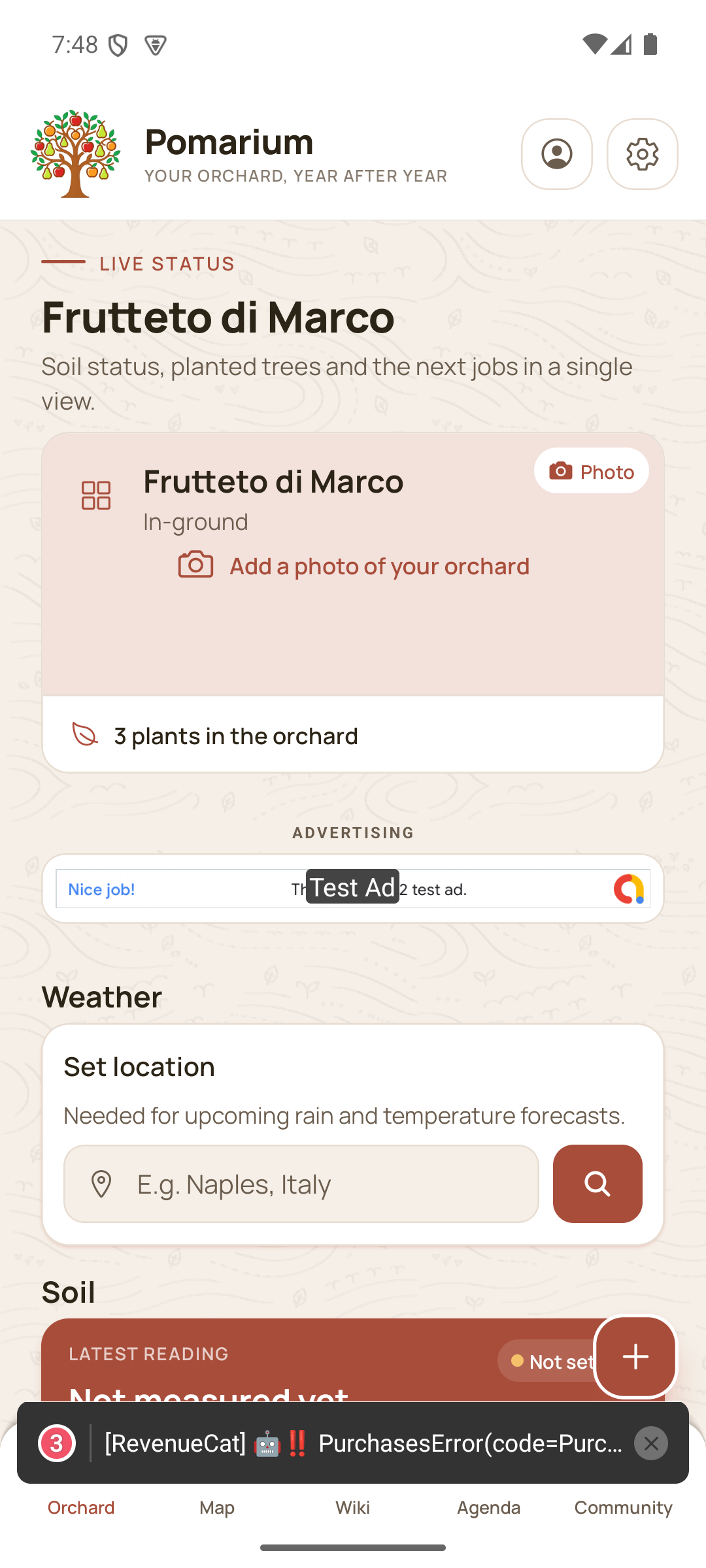
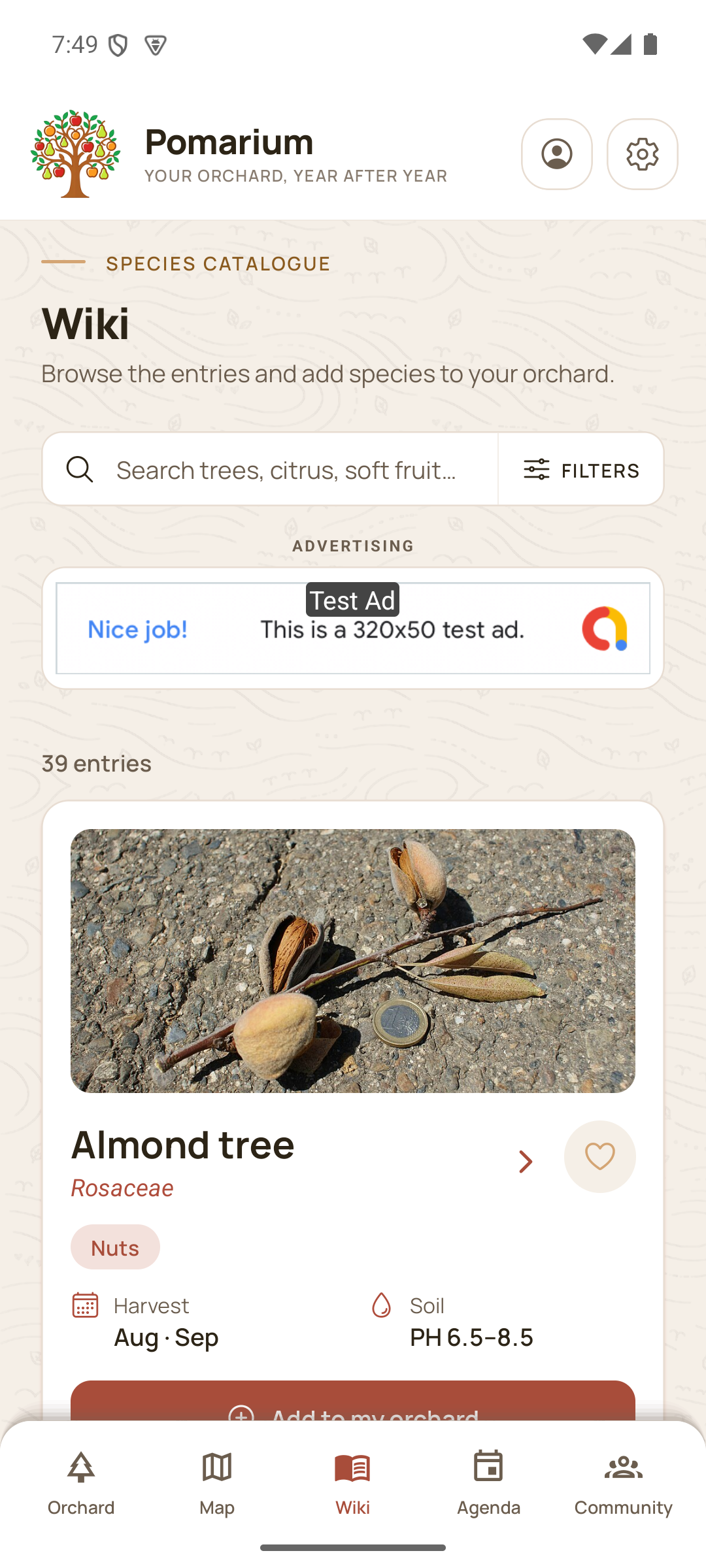
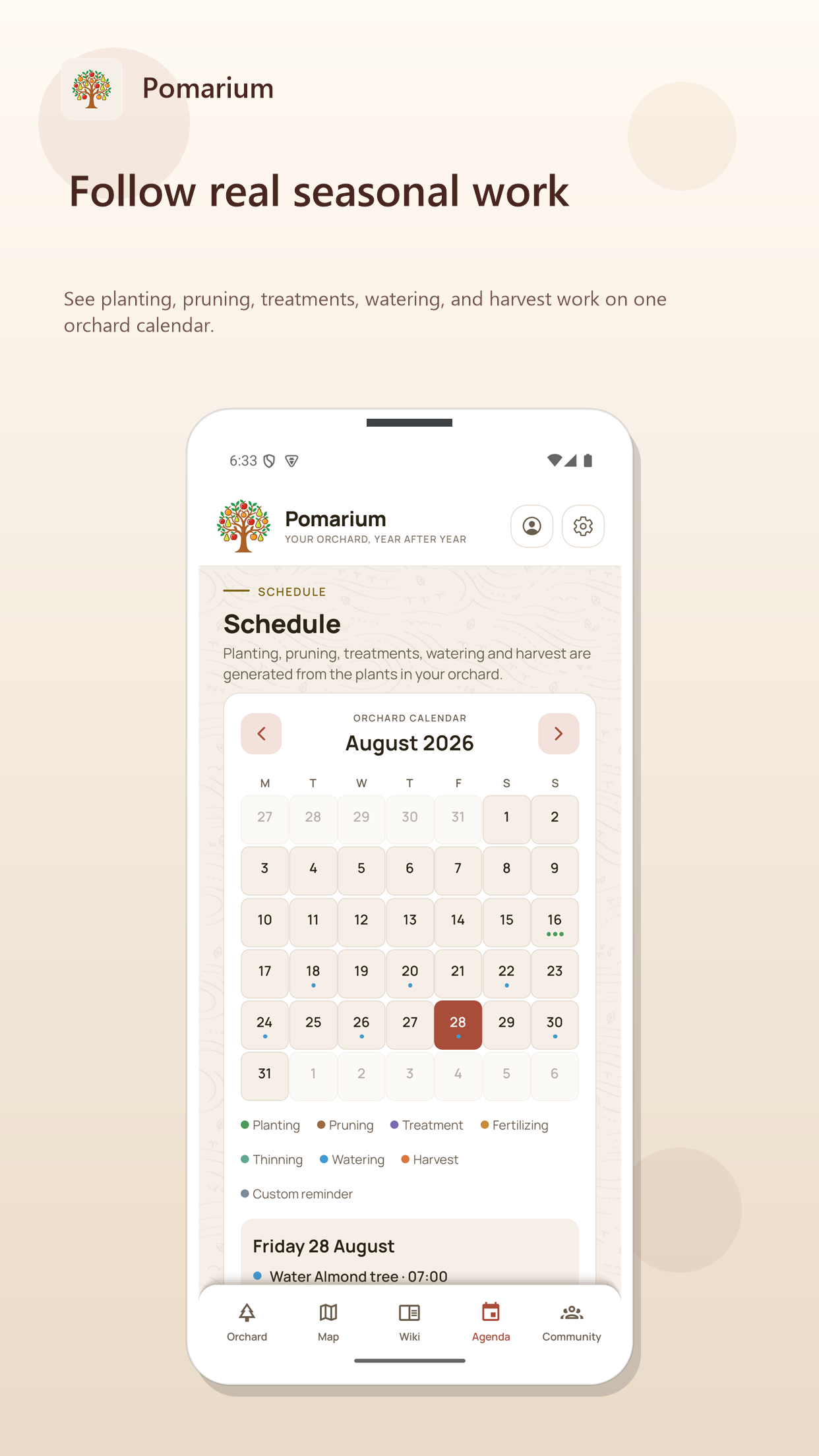
Pomarium brings continuity to orchard care, where trees, interventions, and harvests need memory over time.
What it actually includes
Pomarium follows the orchard tree by tree: species and variety sheets, rootstocks, planting distance, pollination, pruning, treatments, pests and diseases, irrigation, weather, chill hours, harvests, and backup.
Key features
Each plant can have a record connected to variety, position, work, and harvests.
The tools help keep rhythm and priorities clear throughout the year.
It helps when an orchard is not just a list of plants, but a story that changes every season.
Pomarium
The topics this app helps you manage every day.
Prune apple trees in late winter while they're still dormant, ideally from late February to early March, after the coldest weather has passed but before buds swell. Pruning during dormancy lets you see the branch structure clearly and gives wounds time to heal as spring growth begins; avoid pruning in early winter, when cuts heal poorly. Trained forms like espaliers are the exception and are pruned in summer instead. Pomarium's catalog links each tree's species and variety to the right pruning window so you know exactly when to act.
Peach trees are best pruned in late winter or very early spring, just as buds begin to swell but before the tree leafs out — generally not before February in most climates. Pruning too early, right before a hard freeze, can reduce cold-hardiness and damage flower buds and bark. Peaches fruit on one-year-old wood, so annual dormant-season pruning is essential to keep production high. Pomarium's pruning guidance is tailored by species, so peach trees get their own timing separate from pome fruit like apples.
Citrus are best pruned in early spring, roughly February to April, after the coldest part of winter has passed but before the spring flush of new growth. Avoid pruning in summer or fall, when fresh growth coincides with peak citrus leafminer activity and pest damage, and avoid winter pruning since tender new shoots can be hurt by late frosts. Light pruning after harvest is also an option for some types. Pomarium's tree catalog flags citrus varieties separately so their pruning calendar doesn't get mixed up with deciduous fruit trees.
Most fruit trees follow a two-window pattern: a main dormant-season prune from roughly January to early April (before bud break) for structure and size control, and a lighter summer touch-up in July or August to remove water sprouts, suckers, and to manage vigor. Stone fruit like cherries and plums are the exception — they're best pruned in late summer after harvest rather than in winter, since winter cuts leave them more exposed to disease. Because timing varies by species and even by climate zone, Pomarium's harvest and care calendar adjusts pruning windows to your specific trees and zone rather than using one generic schedule.
No — cherries and plums are usually pruned in late summer, after harvest, rather than during winter dormancy. Pruning these stone fruits in winter leaves fresh wounds open longer in cool, damp conditions, increasing the risk of fungal and bacterial infections entering through the cuts. Late-summer pruning lets wounds close faster while the tree is still active. Pomarium's guidance section keeps species-specific rules like this visible so you don't accidentally apply an apple or pear schedule to stone fruit.
Severe pruning removes a large share of a tree's leaf canopy, so the tree redirects its energy into regrowing wood and shoots instead of forming flower buds — this can suppress fruiting for one to three years depending on how hard the cut was. Over-fertilizing has a similar effect by pushing vigorous vegetative growth at the expense of flowering. Moderate, consistent annual pruning avoids this cycle better than occasional heavy cuts. Pomarium's pruning guidance helps you follow a gradual, tree-appropriate pruning plan instead of one-off drastic cuts.
This is almost certainly peach leaf curl, a fungal disease that causes leaves to pucker, thicken, and turn reddish before dropping early. It's caused by a fungus that infects buds in cool, wet spring weather, and by the time curled leaves appear it's too late to treat that season's growth. Prevention is a single copper-based fungicide spray applied while the tree is fully dormant, after leaf drop in autumn or before buds swell in late winter. Pomarium's treatments and recurring-disease guidance reminds you of this dormant-season spray window before symptoms would otherwise appear again next year.
Apple scab is a fungal disease that overwinters in fallen leaves and causes olive-green to black spots on leaves and fruit. Prevention relies mostly on sanitation — raking up and removing fallen leaves and fruit each autumn — plus pruning to open the canopy for better airflow and light so foliage dries faster. Preventive fungicide sprays (such as a copper-based product) applied before symptoms appear are effective, but sprays won't cure fruit that's already infected. Pomarium tracks recurring diseases like this per tree, so you get a reminder before the next wet spring rather than discovering scab after it's spread.
Fire blight is a bacterial disease (Erwinia amylovora) that infects blossoms and shoots, causing them to blacken and look scorched, as if burned by fire — pears are generally more susceptible than apples. It spreads fastest during warm, humid bloom periods, often via pollinating insects or rain splash. Management combines pruning out infected wood well below the visible canker (during dry weather to avoid spreading bacteria) with a pre-bloom copper spray in high-risk areas. Pomarium's pest and disease guidance flags fire blight-prone conditions for pear and apple varieties in your zone so you can catch it early.
Brown rot is a fungal disease affecting peaches, plums, cherries, and apricots, causing fruit to develop soft brown spots that quickly spread and turn fuzzy grey. It thrives in warm, humid weather and enters fruit through wounds from insects, hail, or cracking. Prevention includes removing mummified fruit and dead twigs after harvest, pruning for airflow, and picking fruit promptly at ripeness; a preventive fungicide spray at bloom time helps in high-risk seasons. Pomarium groups stone fruit varieties together in its treatment guidance so recurring risks like brown rot are flagged at the right point in the season.
That's powdery mildew, a fungal disease that coats leaves and young shoots in a fine white film, most common on apples, peaches, and other fruit trees during warm days and cool nights. It thrives with excess nitrogen and poor air circulation, so pruning to open the canopy and avoiding over-fertilizing helps prevent it. Light infections can be trimmed out early; sulfur or horticultural oil sprays are common treatments, though sulfur should not be used on apricots. Pomarium's treatment guidance notes which of your catalogued trees are prone to this disease based on species and pruning history.
Dormant oil is a horticultural oil applied to fruit trees to smother overwintering insect eggs and larvae before they become active in spring. Despite the name, the best timing is actually just after bud swell but before bud break — spraying too early or during freezing températures reduces its effectiveness and can stress the tree. It's commonly used on apples, pears, and plums as a preventive step against several early-season pests. Pomarium's care guidance schedules this kind of seasonal treatment against your local weather and chill data so the spray window doesn't get missed.
The two most common pear diseases are fire blight, a fast-spreading bacterial infection that blackens blossoms and shoots, and pear scab, a fungal disease causing dark lesions on leaves, fruit, and twigs. Fabraea leaf spot and powdery mildew are also frequent problems, especially in warm days with cool, humid nights. Good sanitation, airflow through pruning, and choosing resistant varieties where possible reduce the risk of all of them. Pomarium's recurring-disease tracking is organized by species, so pear-specific risks like these are surfaced separately from apple or stone fruit issues.
Common citrus pests include aphids, several types of scale insects, spider mites, whiteflies, mealybugs, and leafminers, which tunnel through young leaves and cause them to curl and distort. Most are managed with horticultural oil, insecticidal soap, or targeted pruning to remove heavily infested growth, combined with keeping the tree healthy through proper watering and sunlight. Avoiding pruning right before the vulnerable new-growth flush also limits leafminer damage. Pomarium's pest guidance is grouped by species, so citrus-specific pests are distinguished from those affecting pome or stone fruit in your catalog.
Spacing depends heavily on rootstock and species: standard apple trees need roughly 30-35 feet between them, semi-dwarf apples about 15 feet, and dwarf apples as little as 10 feet; peaches are typically spaced around 20 feet, and citrus trees can be planted about 8 feet apart. Crowding trees too closely reduces airflow and light, which increases disease pressure and lowers fruit quality, while wider spacing gives room for full canopy development. These figures are guidelines that should be adjusted for your specific variety and rootstock. Pomarium's orchard grid management uses real planting distances for each tree and warns you if two trees are placed too close together.
Most apple trees are self-unfruitful, meaning they need pollen from a different, compatible apple variety (or a flowering crabapple) blooming at the same time to set a good fruit crop. A few varieties, like Golden Delicious, can produce some fruit on their own, but yields are usually better with a cross-pollinator nearby. Trees generally need to be within about 50-100 feet of each other for bees to move pollen effectively between them. Pomarium runs a pollination check for each variety in your catalog and flags whether it needs a compatible companion nearby.
Good general pollinators include Golden Delicious, Honeycrisp, and Jonathan, as well as flowering crabapples, which bloom over a long period and pollinate many apple varieties well. The key requirement is that the partner variety blooms at the same time (the same or an overlapping bloom group) and is a genetically compatible, non-triploid apple — triploid varieties like Mutsu and Jonagold produce sterile pollen and can't pollinate other trees themselves. Getting this wrong is one of the most common reasons a healthy-looking tree fails to fruit. Pomarium's pollination checks compare bloom timing and compatibility across your catalogued varieties so you can spot mismatches before planting.
A fruit tree is actually two parts grafted together: the scion (the variety that determines the fruit) and the rootstock (which determines the tree's ultimate size, vigor, disease resistance, and how young the tree starts fruiting). Dwarfing rootstocks keep trees around 6-12 feet tall, semi-dwarfing rootstocks produce trees roughly 12-20 feet tall, and standard rootstocks can grow trees up to 35 feet. Choosing the right rootstock is often more important for a home orchard than choosing the variety itself. Pomarium's tree catalog records rootstock alongside variety, soil, and water needs so this information stays attached to each tree you plant.
The difference comes down to rootstock: dwarf trees, grown on dwarfing rootstock, typically reach 6-12 feet tall and can start bearing fruit in just 1-2 years, making them easy to prune and harvest without a ladder. Semi-dwarf trees are more vigorous, usually 12-20 feet tall, and are a good middle ground for growers who want a sturdier, longer-lived tree but don't have space for a full-size standard. Both need less space than standard trees, which grow to full size around 30-35 feet. Pomarium's catalog entry for each tree includes its rootstock and expected mature size, helping you plan spacing before you plant.
Citrus trees are generally planted about 8 feet apart, though exact spacing depends on the variety and whether it's grown on a dwarfing rootstock, which can allow tighter spacing in containers or small gardens. Adequate spacing matters for citrus because good airflow helps reduce pest and fungal pressure, especially during the vulnerable new-growth flush. As with other fruit trees, mature canopy size should guide the final distance rather than the size of the young nursery tree. Pomarium's orchard grid tool checks your planned layout against real spacing guidelines and warns about proximity issues before you dig.
Look for the background skin color shifting from green to yellow (even on red varieties), and try the twist test: a ripe apple lifts off the branch with a slight upward twist, stem attached — if you have to force it off, it isn't ready yet. Cutting one open is a reliable check too, since ripe apples have brown seeds rather than white or pale ones. Natural fruit drop beginning is another sign that harvest is due. Pomarium's harvest calendar estimates picking windows for each tree based on its species, zone, and rootstock so you're not relying on guesswork alone.
Peaches are typically ready from late June through August depending on variety and climate, and unlike some fruits, they will not continue to ripen once picked, so timing on the tree matters. Look for the green background color fully turning to yellow near the stem, a gentle give when squeezed, and a sweet, fragrant smell; a taste test is the most reliable final check. Red skin coloration alone is not a good ripeness indicator, since some varieties are red well before they're ripe. Pomarium's harvest calendar links expected ripening windows to your tree's species and local zone.
Unlike most fruit, pears should be picked before they fully ripen on the tree, since tree-ripened pears often turn mealy inside. Watch for the skin background color starting to shift from deep green to a lighter green or yellow, and test by tilting the fruit horizontally — a mature pear separates easily from the branch at this angle. Once picked, let pears ripen at room température for one to two weeks before eating. Pomarium's harvest calendar accounts for this early-pick behavior specifically for pear varieties in your catalog.
Chill hours measure the cumulative time a deciduous fruit tree spends below about 45°F during its dormant winter period, and most varieties need a minimum chill total to properly break dormancy, bloom evenly, and set fruit in spring. Requirements vary widely by variety, from under 500 hours for low-chill types suited to mild climates to 800-1,000+ hours for varieties bred for cold northern winters. If a tree doesn't get enough chill, it may bloom late, unevenly, or produce a reduced, lower-quality crop. Pomarium tracks local weather and chill hour accumulation and matches it against each variety's needs in your catalog.
Mature fruit trees generally do best with deep watering every 2-3 weeks during the growing season rather than frequent shallow watering, since deep watering encourages deeper, more drought-resilient roots — the exact interval depends on rainfall, soil type, and heat. Newly planted trees need more frequent attention, often a thorough watering once or twice a week for the first couple of months while roots establish. Heavy clay soils need less frequent but still deep watering, while sandy soils dry out faster and may need more frequent irrigation. Pomarium's tree catalog stores water needs alongside soil type for each tree so watering guidance matches your actual conditions.
A newly planted tree needs regular watering, often around 15 gallons twice a week, for its first two to three months while its root system establishes itself in the surrounding soil. Once established and mature, the same tree can shift to deeper but less frequent watering, roughly every 2-3 weeks in summer, since its wider root system can draw moisture from a larger area of soil. Watering too often on either stage, especially in heavy soil, risks root rot rather than helping the tree. Pomarium's catalog keeps water requirements tied to each tree's age, soil, and species so recommendations adjust as your tree matures.
The most common causes are excessive vigor from over-fertilizing or over-pruning (which pushes the tree into growing wood instead of flower buds), insufficient sunlight, lack of a compatible pollinator, tree age (young trees often need several years before fruiting), or a biennial bearing pattern where a heavy crop one year is followed by little to no fruit the next. Weather during bloom, like cold snaps or heavy rain, can also disrupt pollination. Because the cause varies so much by species and situation, tracking a tree's history over multiple seasons helps narrow it down. Pomarium's catalog and pollination checks bring together variety, rootstock, and companion-planting information to help you identify which of these factors applies to your tree.
Official store links are not available yet.
Link in preparationLink in preparation