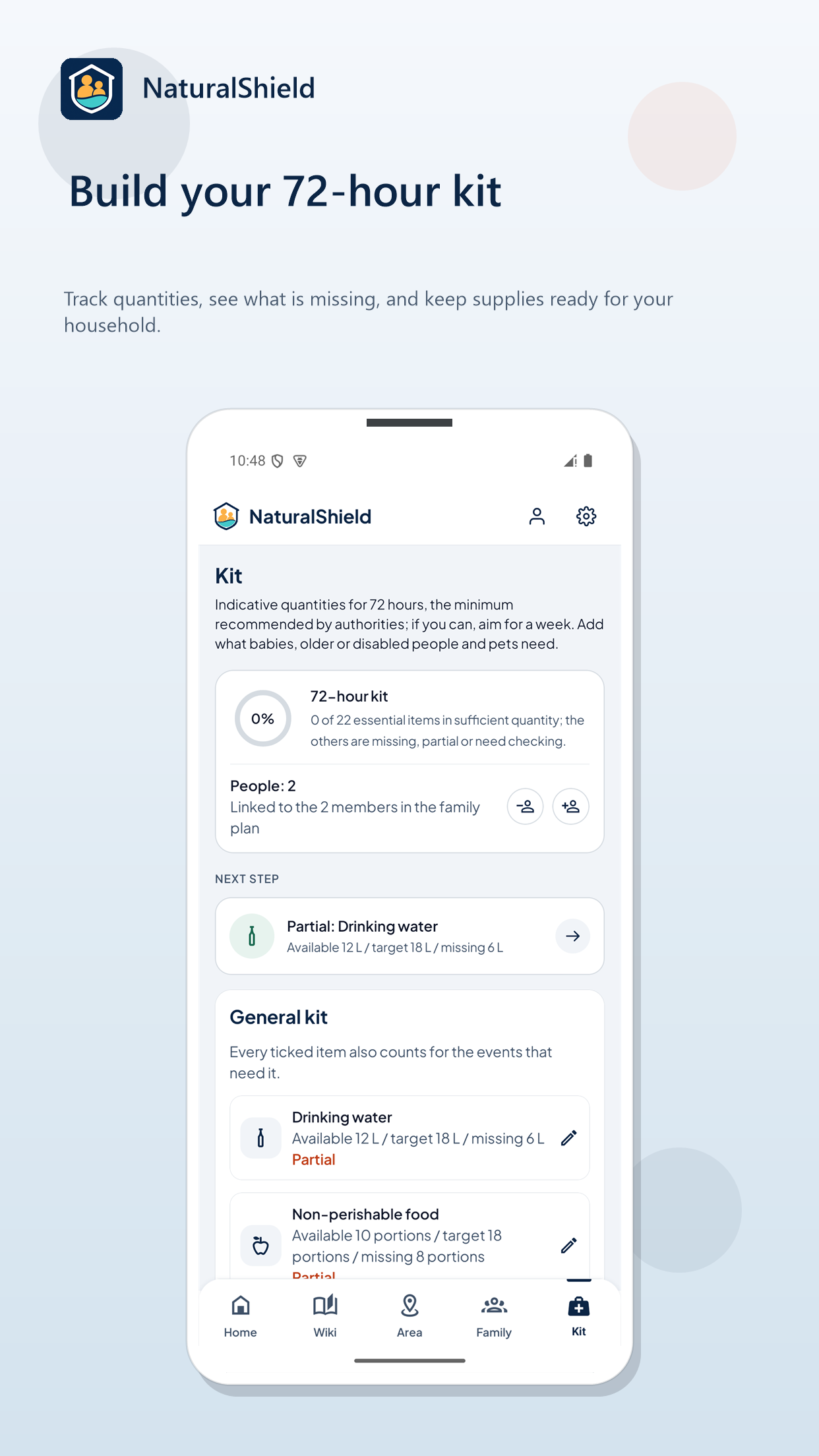
What goes into a 72-hour emergency kit?
A 72-hour kit gathers what you need to manage on your own in the first days of an emergency: drinking water, non-perishable food, a flashlight, a battery or hand-crank radio, personal medicines, copies of documents, cash, a power bank and cables, a first aid kit, a whistle, and hygiene products. Quantities depend on how many people and pets are in your household. In NaturalShield you can mark what you already have, see what is missing, and get reminders for expiry dates.
What should I do during an earthquake?
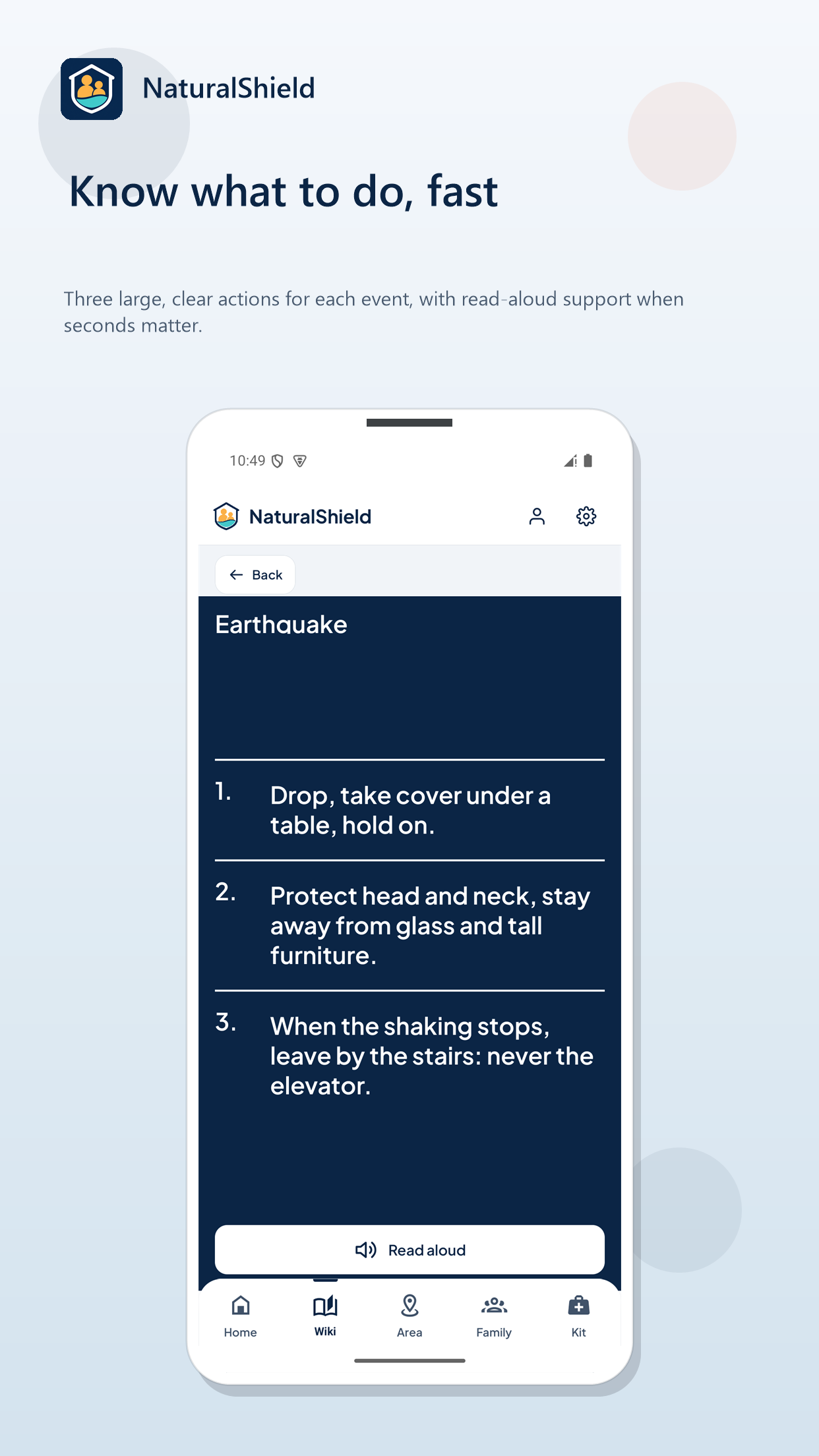
The general self-protection guidance is to take cover under a sturdy table or next to a load-bearing wall, protect your head and neck, stay away from glass and tall furniture, and, when the shaking stops, leave by the stairs without using the elevator. NaturalShield presents these steps on a large-print quick card with read-aloud, alongside what to do before and after. Always follow the instructions of local authorities.
Does NaturalShield work without a connection?
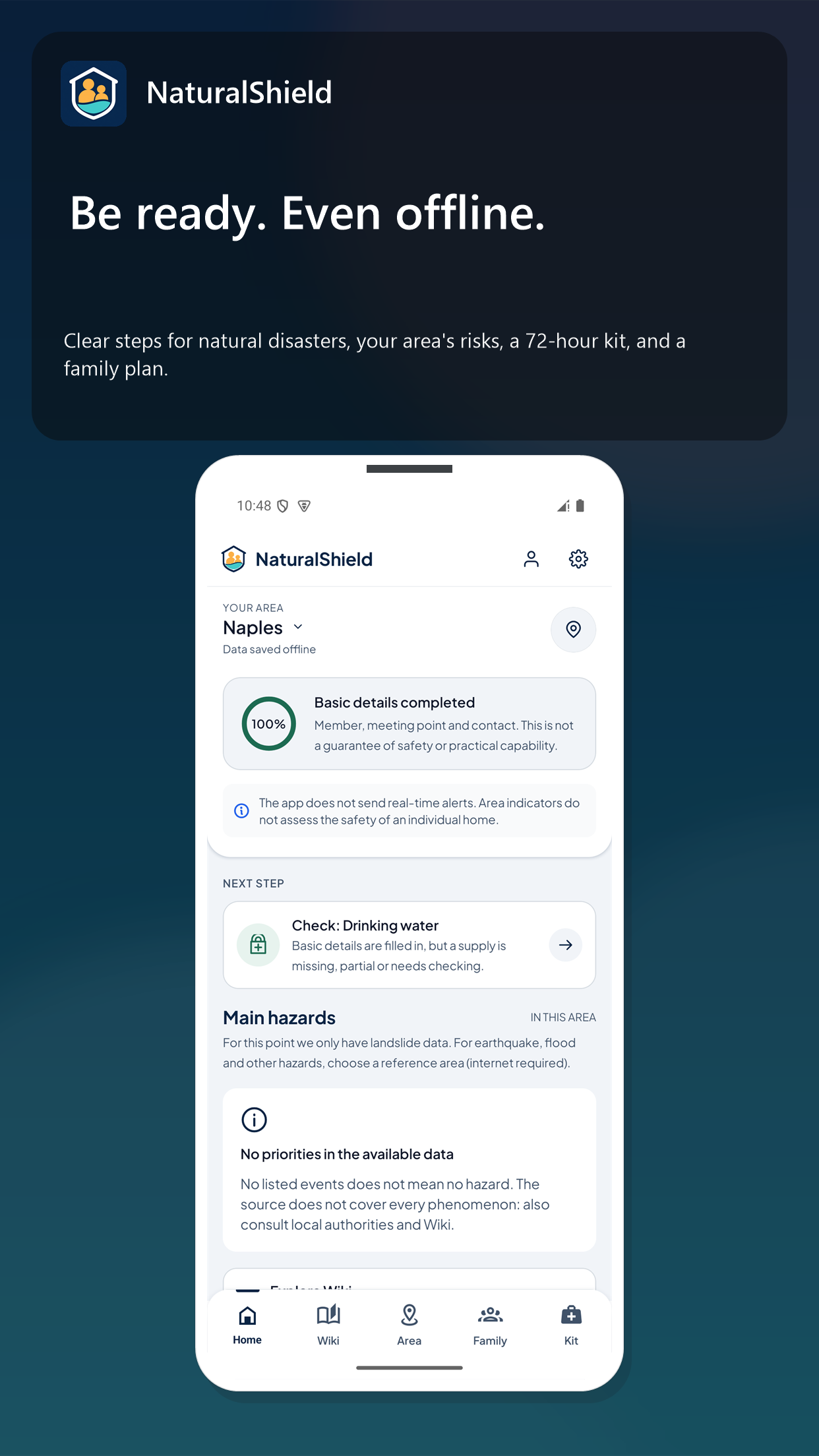
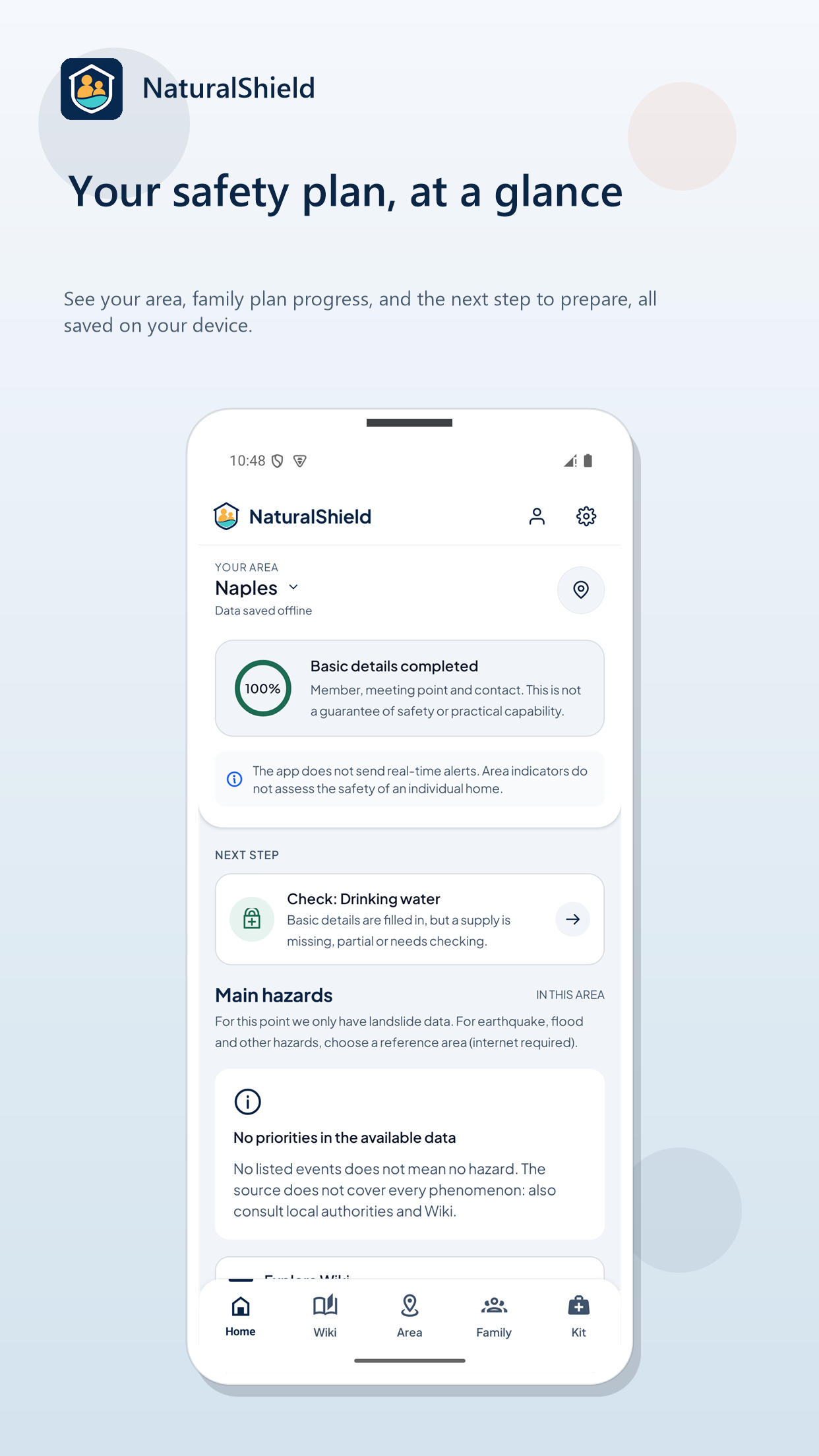
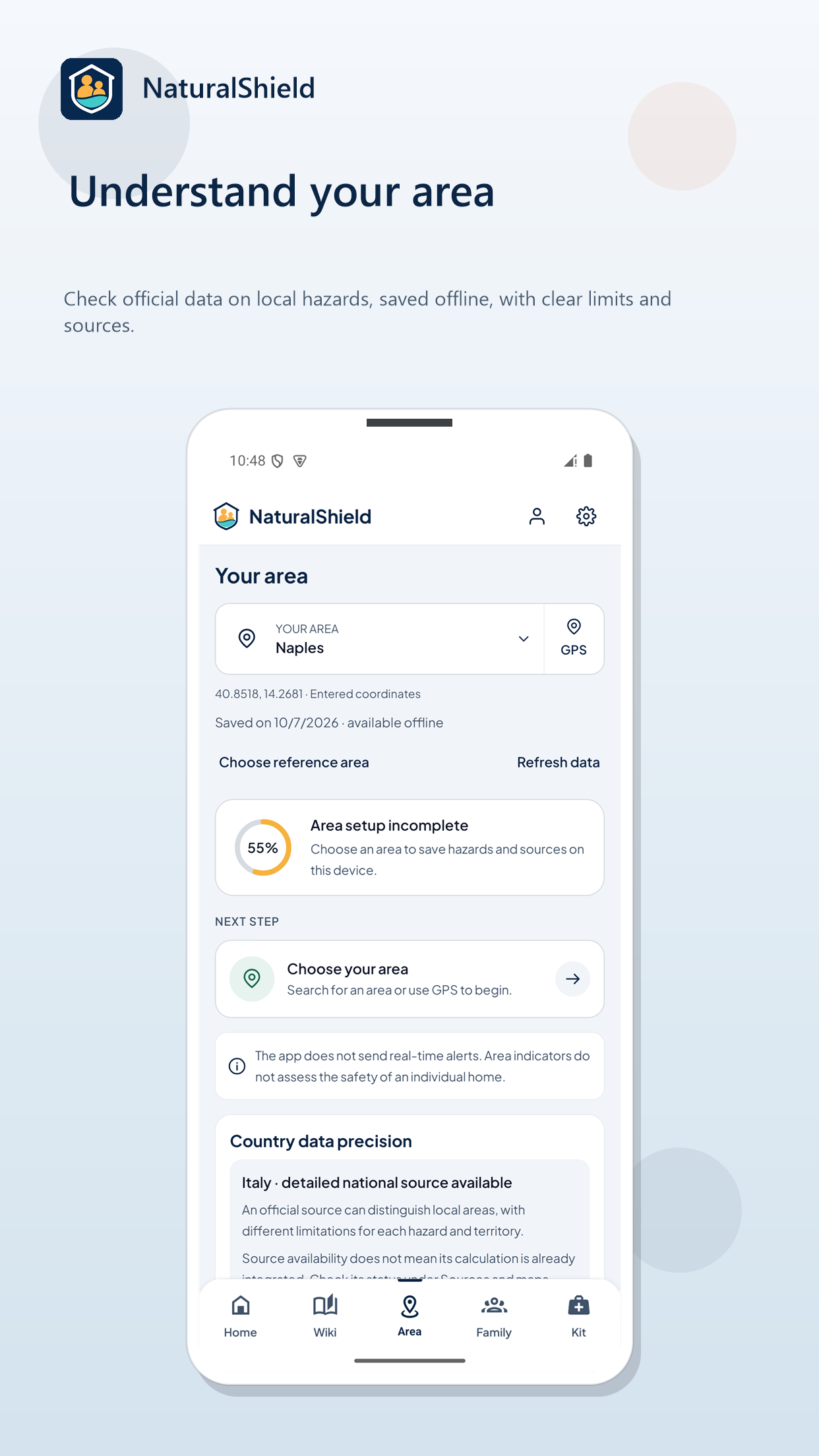
Yes: guides, quick cards, quizzes, and the kit are inside the app and can be read in airplane mode, with no account. Searching for a place needs the internet, but area data you have already saved stays available offline. The app does not send real-time alerts: for official alerts, refer to the channels of the competent authorities.
Does NaturalShield replace official alerts?
No. NaturalShield is a preparedness tool: it helps you know what to do, organize your kit and family, and understand the risks in your area. It is not an alert system and does not assess the safety of an individual home. In an emergency, follow official instructions and call your local emergency number.
How do I prepare a family emergency plan?
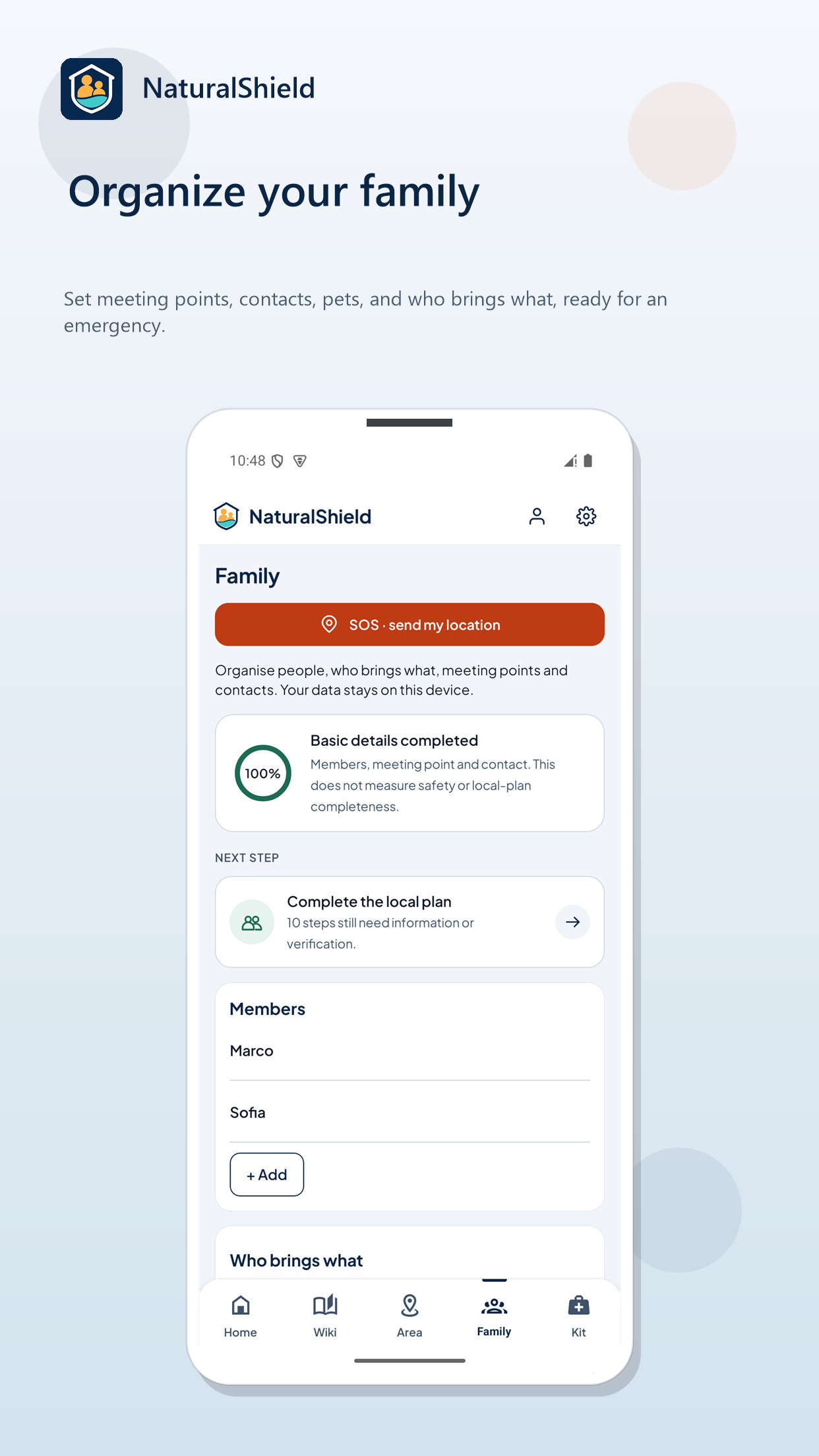
A family plan lists who is in the household (pets included), a meeting point near home and one away from the area, the contacts to notify, and who brings which kit items. Having it written down in advance helps you decide quickly when it matters. NaturalShield gathers these details in a guided plan, with SOS to send your location.
Are NaturalShield's safety instructions free?
Yes. Guides, quick cards, quizzes, local risks, and the basic kit stay free, because no safety instruction sits behind a paywall. An optional one-time purchase unlocks the more advanced organization tools, such as the full family plan, the kit inventory with expiry dates, and PDF export.
Which natural disasters does NaturalShield cover?
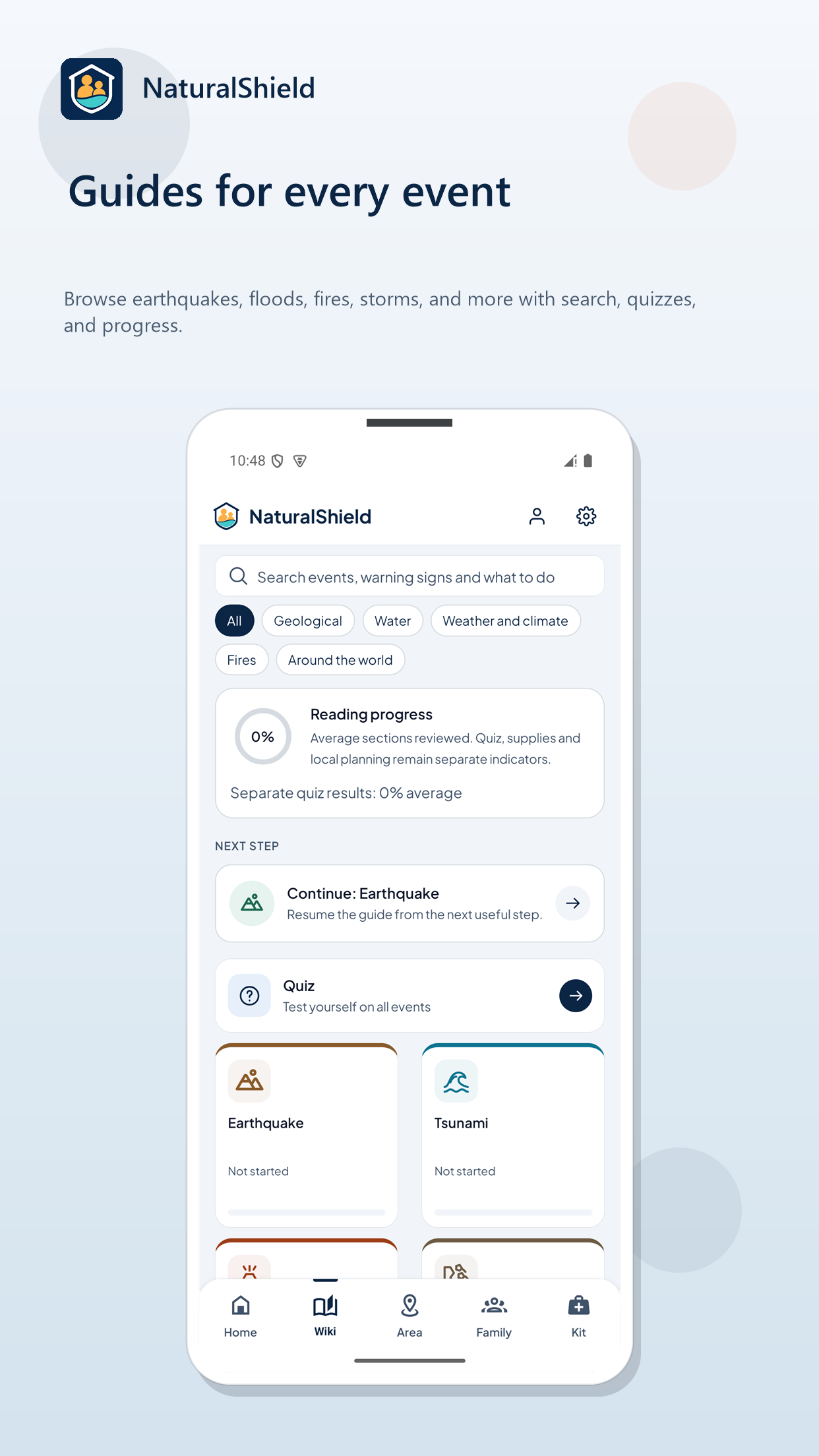
NaturalShield has 16 guides: earthquake, flood, flash flood, storm surge, tsunami, landslide, avalanche, volcanic eruption, wildfire, tornado, severe thunderstorm, tropical cyclone, heavy snowfall, heatwave, cold wave and drought. Each guide explains what the event is, how to recognise the warning signs, what to do before, during and after, the mistakes to avoid and common myths, with a quiz and cited official sources.
What should I do in a flood?
The basics are to go to an upper floor or a high place, avoid basements, garages, underpasses and flooded roads, and never drive or walk through floodwater: a few tens of centimetres of moving water can knock a person down or carry a car away. In a flash flood, move up at once, without waiting to see the water. NaturalShield puts these steps on a quick card and separates them by where you are: at home, in a car or outdoors.
What should I do in a wildfire?
Move away from the fire, never uphill and never downwind, cover your nose, mouth and skin, and stay low in smoke. If an evacuation order arrives, follow it immediately and call 112 or 115. The NaturalShield guide also explains how to prepare on days of extreme danger, where to shelter if caught in a car, and which mistakes to avoid, such as wetting a blanket in a car, which produces scalding steam.
What should I do in a tsunami?
Move away from the sea at once, even without an alert, and climb as high as you can, on foot. Do not return to the coast until the authorities allow it. The most common cause is a strong earthquake under the seabed or near the coast, and in the Mediterranean the waves can arrive a few minutes after the shock, when there is often no time for an official alert. The NaturalShield quick card sums these steps up in large type, with voice reading.
How should I behave in a heatwave or a cold wave?
In heat, stay cool, drink often even when not thirsty, never leave people or animals in a closed car, and call 112 if hot skin, confusion or fainting appear. In cold, dress in dry layers, never use improvised heaters or generators indoors because of carbon monoxide, and call 112 if confusion and drowsiness appear. NaturalShield does not explain treatments: it points to official health websites.
What should I do in a volcanic eruption?
If the authorities order an evacuation, leave immediately. When ash falls, stay indoors with doors and windows closed; outdoors, wear an FFP2 mask and goggles and stay away from valleys, where mudflows can run. People with breathing or heart problems should ask a doctor before using filter masks. The NaturalShield guide is built on official sources from the most exposed countries, such as Japan.
What should I do if there is a landslide?
Move away at once, sideways from the landslide's path, and reach high, stable ground away from streams and channels. If that is not possible, curl up and protect your head. Afterwards call 112 if people are involved, telling rescuers where they were. The guide also lists signs that can come before one, such as new cracks in walls or the ground and streams that suddenly turn muddy.
What should I do in an avalanche?
If you are caught, try to get out sideways, grab hold of something and fight to stay on the surface, making an air space in front of your mouth. If a companion is caught, call 112 and start searching immediately with a transceiver (ARTVA), probe and shovel: the first 15 minutes are decisive. NaturalShield sums these steps up in its avalanche guide, based on specialist sources such as Swiss ones.
What should I do in a tornado or a severe thunderstorm?
In a tornado, go to an interior room without windows on the lowest floor, curled up with your head and neck protected, and never under an overpass or in mobile homes or tents. In a severe thunderstorm, if you hear thunder go indoors or into a car at once, stay away from trees, ridges, water and metal objects, and go out only 30 minutes after the last thunder.
How much water do I need in a 72-hour emergency kit?
NaturalShield indicates 3 litres per person per day for 3 days, that is 9 litres per person, for drinking and cooking, in line with the recommendations of Japan, Switzerland and the Netherlands. Some sources, such as Ready.gov, indicate about 3.8 litres a day including hygiene needs. The kit in the app takes the number of people and pets into account and shows what is missing.
What should I put in an emergency backpack to take if I have to evacuate?
An evacuation backpack holds the essentials for leaving home quickly: water and non-perishable food, a torch, a radio, batteries and a power bank, personal medicines, documents, cash, a first aid kit, a whistle, and a mask and blanket for each person. In NaturalShield the kit items are split by event and you can mark what you already have, to see what is missing before you need it.
How often should I check the expiry dates of my emergency kit?
It is best to check the kit regularly, because food, water, batteries and medicines have different expiry dates. NaturalShield records the expiry date of each inventory item and sends a reminder before it expires, so the kit stays usable without you having to remember. When you open the app with a connection, it also checks the sources for your saved places every six months.
How do I include pets in an emergency plan?
Pets should be treated as family members: you need to know where to take them, have food, water, a lead or carrier and copies of their documents, and include them in the plan. In NaturalShield the family plan covers people and pets, with meeting points, contacts and who carries what, so nobody has to improvise during the emergency.
How do I choose a family meeting point?
Choose two places: one near home, for when you have to leave at once, and a farther one, outside the affected area, if you cannot go back. Open areas that are easy to reach on foot and known to everyone are best, including those named in your municipality's civil protection plan. In the app you can record the meeting points and the walking route to reach them, and share them with the family.
What is the SOS button in NaturalShield for?
The SOS button prepares an SMS with your position to send to the family members you choose: one tap opens the message and one sends it. Your position stays on the phone and is shared only in the message you send. It does not replace a call to 112 or the local emergency number: in immediate danger, call the official number first.
Where do the local risks shown in the app come from?
Local risks come from official sources, such as ISPRA and the Civil Protection Department for Italy, and from international public datasets for other countries, and they are saved on the device so you can consult them offline too. They show how exposed a place is to events such as earthquakes, landslides and floods, but they do not assess the safety of a single building and do not replace a technician's advice.
Which languages is NaturalShield available in?
NaturalShield is available in 27 languages, including Italian, English, German, French, Spanish, Portuguese, Arabic, Hindi, Japanese, Chinese and Filipino, with the same content structure in every language. The text of all guides is translated, but the official sources cited stay the original ones from each country. You change language from the app settings.
Does NaturalShield collect personal data or need an account?
No: the app works without an account, and the data you enter, such as kit, family plan and saved places, stays on the device. Your position is used only when you press SOS or choose “Use my location”, to show local risks or to put coordinates in the message. The free version shows ads; the one-time Pro purchase removes them and unlocks the more advanced organising tools.
Does NaturalShield give first aid instructions?
No. NaturalShield explains how to prepare and how to behave during an event, but it does not teach how to treat illness or injuries. For first aid it points to official health websites, such as the NHS, the CDC and the National Weather Service for lightning, and in an emergency to 112 or the local emergency number. The first aid kit appears only as an item to keep at home.
Can I trust NaturalShield's safety instructions?
Each guide is based on official documentation and lists its sources with links and the date consulted: for example the Italian Civil Protection, FEMA and Ready.gov, the Japan Meteorological Agency and the US National Weather Service. When authorities in different countries disagree, the guide says so instead of hiding it. When in doubt, the local authorities' instructions always prevail.

 Link in preparation
 Link in preparation