
Features
Each object can become a complete record, with practical information and personal memory.
- Catalog with photos, documents, notes, and values
- Details about materials, stones, origin, and history
- Archive available without a mandatory account
Collections · Product
Objects, memories, and stories in a personal archive.
 Link in preparation
Product
My Gemory gives personal collections a digital home, connecting every object with the information and memories that make it meaningful.
Cataloging stays simple and visual, so finding a detail or revisiting a story takes only a few gestures.
Inside the app
Real app screens, updated as the product evolves.
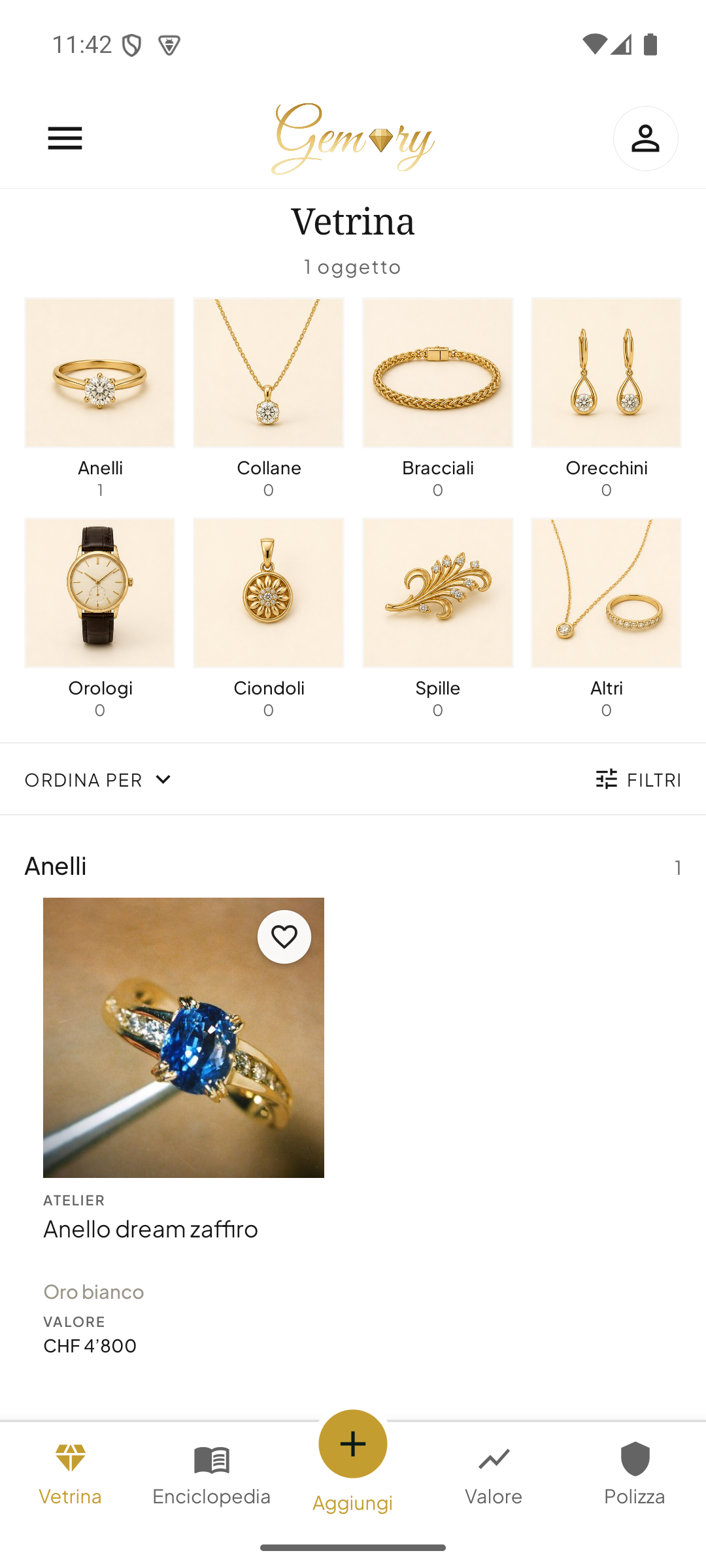
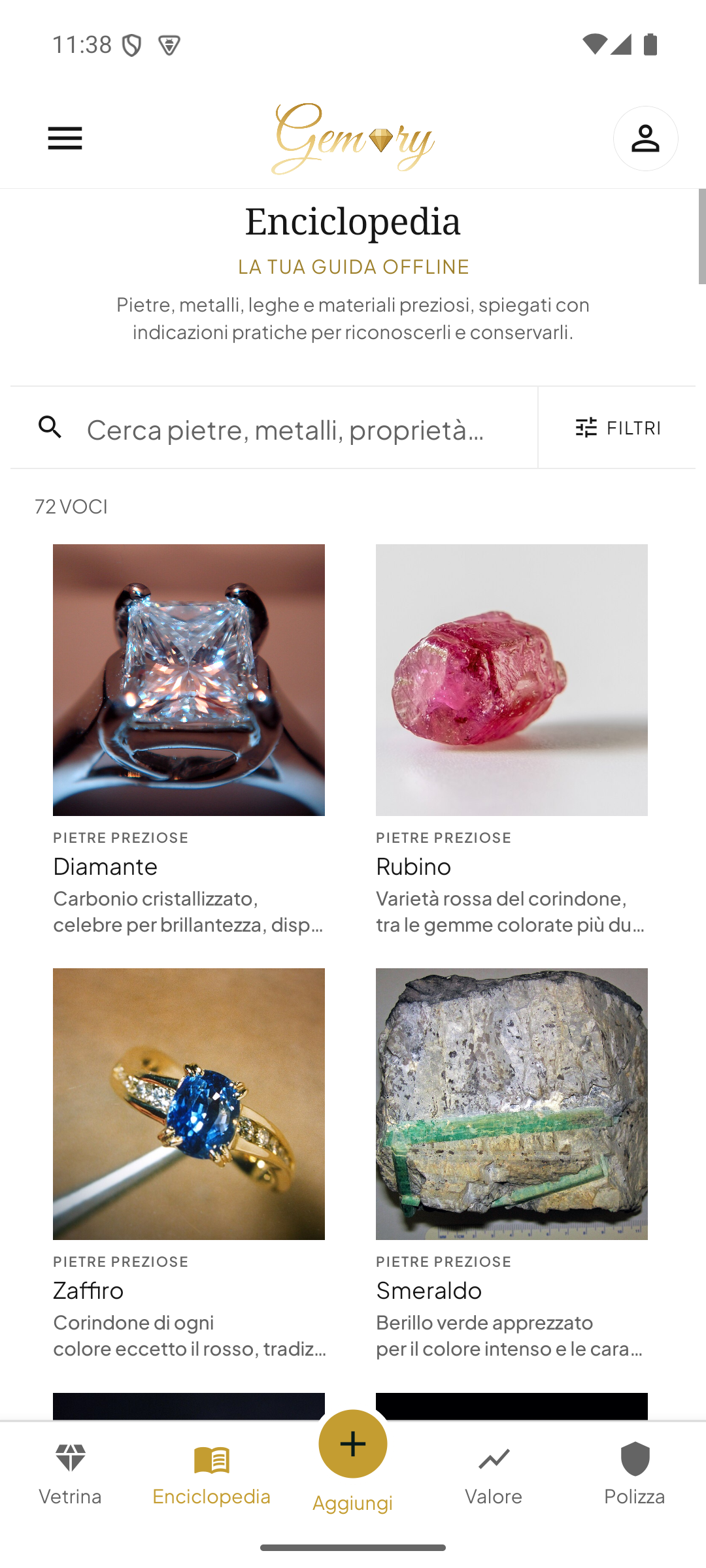
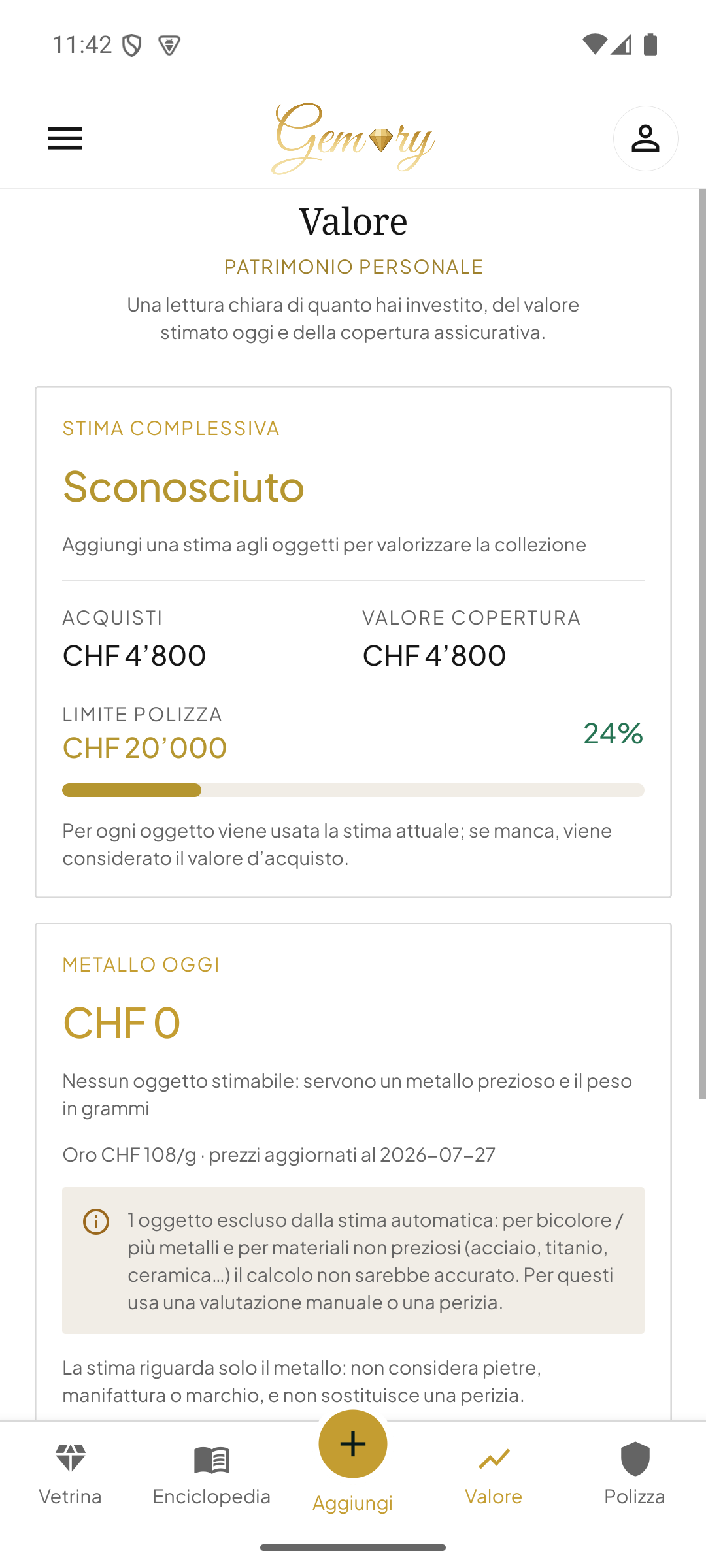
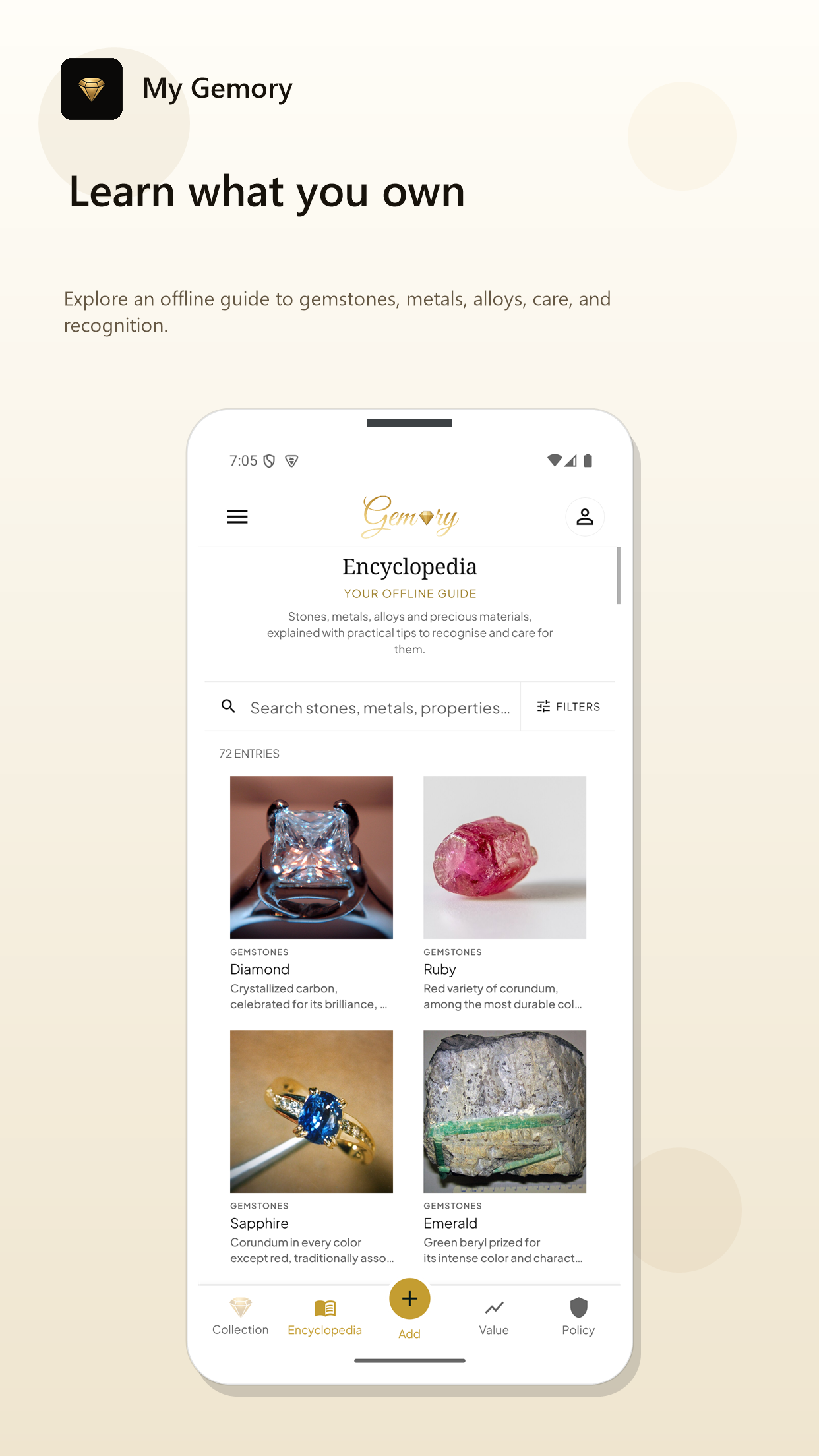
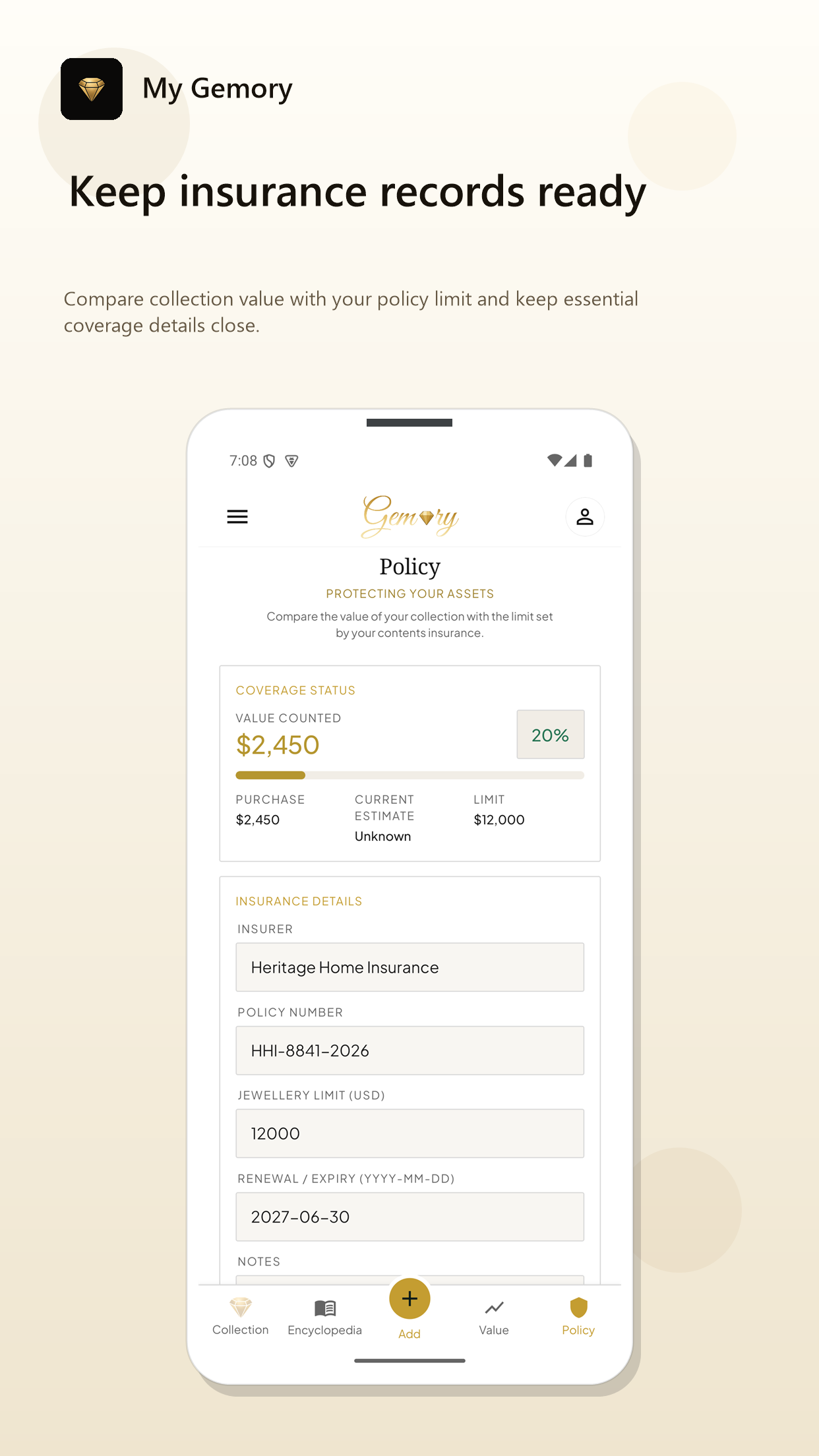
My Gemory is designed to build a personal archive of objects, jewellery, and memories without losing details, images, and documents.
What it actually includes
My Gemory creates a local-first archive for jewelry and important objects: each entry can hold photos, material, gemstones, receipts, certificates, history, purchase value, estimates, metal prices, and an exportable insurance dossier.
Key features
Each object can become a complete record, with practical information and personal memory.
The tools help you find, estimate, and protect important information.
It becomes useful when a collection grows and details cannot live only in memory.
My Gemory
The topics this app helps you manage every day.
Start by listing each piece individually rather than lumping them together — for every item, note a clear photo, a description, the materials and gemstones involved, when and where you got it, and any story behind it. Photograph each piece from multiple angles, including any hallmarks or engravings, since these details matter if you ever need to prove ownership or identify a piece later. Many collectors begin with a spreadsheet or notebook, but a piece-by-piece digital record is easier to search and update as the collection grows. My Gemory is built around this idea: an inventory where every object gets its own entry with photos, notes, materials, and gemstone details in one place.
A useful jewelry record generally includes a physical description, materials (gold, silver, platinum), gemstones and their characteristics, weight, any hallmarks or maker's marks, the date and circumstances of acquisition, and photos from several angles. Keeping notes on repairs, resizing, or previous owners also builds a fuller picture of the piece over time. This kind of detail is what turns a photo album into a real archive you can rely on. In My Gemory, each object has dedicated fields for materials, gemstones, notes, and history, so this information stays attached to the piece it belongs to.
The most reliable approach combines photos, written details, and any supporting paperwork (receipts, appraisals, certificates) kept together for each item rather than scattered across drawers and folders. Update the record whenever something changes — a new purchase, a repair, a re-appraisal — so it stays accurate over time. Whether you use a spreadsheet or a dedicated app, consistency matters more than the tool itself. My Gemory gives each object a single place to hold its photos, notes, and documents, so tracking a collection doesn't rely on remembering where everything is filed.
Rather than keeping receipts in one drawer, certificates in another, and photos on your phone, it helps to link every document directly to the specific item it belongs to. That way, when you need a certificate or receipt, you're not searching through unrelated files. Digital storage also protects paper documents from damage or loss over time. My Gemory lets you attach receipts and certificates directly to the single object they belong to, so the paperwork and the item stay connected.
Provenance is the documented history of a piece — who owned it, where it came from, and how it changed hands over time. It's built from photographs, receipts, written accounts, and any gemological reports, and it can matter both for sentimental reasons and because a well-documented history can support a piece's value, especially for antique or estate jewelry. Concrete evidence carries more weight than memory alone. My Gemory includes a dedicated space for provenance and history on each object, so that context isn't lost over time.
Most inventory apps require sign-up before you can use them, which can be a barrier if you just want to start cataloging quickly or prefer to keep the data private. Look for tools described as 'local-first,' meaning the information is stored on your device rather than requiring a cloud account to function. This also tends to mean faster access and fewer dependencies on an internet connection. My Gemory's archive is available without a mandatory account, following a local-first approach so you can start cataloging right away.
Beyond the initial purchase, a piece's history can include repairs, appraisals, gifting, or being passed down — each of these adds context that's worth recording as it happens rather than trying to reconstruct it later. Dating each note and attaching any related documents keeps the timeline accurate. This ongoing record is often what distinguishes a casual collection from a well-documented one. My Gemory lets you add notes and history entries to each object over time, building a timeline alongside its photos and documents.
A professional appraisal from a certified gemologist is the most reliable way to establish value, since it accounts for metal purity, gemstone quality, craftsmanship, and condition. For a preliminary idea, you can check hallmarks for metal purity, weigh the piece, and research comparable items, though this only gives a rough estimate rather than a formal valuation. Because these factors change over time, it's worth revisiting a piece's estimated value periodically rather than treating one figure as permanent. My Gemory includes a value estimation and history feature for each object, so you can track how your understanding of a piece's worth evolves.
Gold value depends on purity (karat), weight, and the current market price of gold — an 18K piece, for instance, is 75% pure gold, so its melt value comes from that percentage times its weight times the going rate per gram. That said, melt value is just the metal's worth; many pieces are worth more because of brand, craftsmanship, gemstones, or collectability. Because gold prices fluctuate, any calculation is a snapshot rather than a fixed number. My Gemory supports value estimation for precious metals, including tracking changes over time rather than relying on a single one-off figure.
Diamonds are generally evaluated on the '4 Cs' — carat weight, clarity, color, and cut — with even small differences in color or clarity noticeably affecting price. Cut quality in particular determines how well a diamond reflects light, which is a major factor in its visual appeal. Market demand for certain shapes or styles, along with certification from a recognized lab, also plays into how a diamond is valued. My Gemory lets you record gemstone details for each piece, so this kind of information stays attached to the object rather than living only in a certificate you might misplace.
Yes — most mass-produced, retail jewelry loses value quickly after purchase, while fine, rare, or antique pieces can hold or even increase in value, particularly if they include quality gemstones or precious metals. Metal and gemstone markets shift over time, and condition, provenance, and changing tastes all play a role too. Because value isn't static, it's worth checking in on a piece's estimated worth periodically rather than assuming an old number still applies. My Gemory keeps a value history for each object, so changes in estimated worth are recorded over time instead of being lost.
Simple home tests include checking for a hallmark or stamp indicating karat, a magnet test (gold isn't magnetic), and a float test in water, though none of these are fully conclusive on their own. For a definitive answer, a jeweler can run an acid test or use electronic testing equipment. Once you know a piece's purity, it's worth recording it alongside the item rather than relying on memory. My Gemory has a dedicated materials field for each object, so purity and metal type can be noted directly in the piece's record.
If you purchased or had a piece appraised in a different currency, its value in your home currency shifts as exchange rates move, separate from any change in the piece itself. This matters when comparing an original purchase price to a current estimate, or when documenting value for insurance in your local currency. Keeping the original currency alongside a converted figure gives a clearer picture than converting once and forgetting the original number. My Gemory's value estimation supports currency exchange, so pieces acquired abroad can be tracked consistently over time.
You can insure jewelry either by scheduling it under your existing homeowners or renters policy (adding a rider for the specific item) or through a standalone jewelry insurance policy, which often covers additional scenarios like mysterious disappearance. Most insurers will ask for an appraisal or detailed receipt, along with photos, before setting coverage. Because insurers rely on documentation to determine both the premium and any future claim payout, having everything ready in advance makes the process smoother. My Gemory lets you export an insurance dossier in PDF with an object's data, images, and available documents, ready to share with an insurer.
In most cases, yes — insurers typically require a professional appraisal to set a coverage limit and premium, especially for older, inherited, or custom pieces. For some recently purchased items, a detailed sales receipt may be accepted instead. Either way, the insurer will refer back to that original documentation if you ever file a claim, so it's worth keeping it accessible rather than filed away and forgotten. My Gemory stores receipts and appraisal documents linked directly to each object, so they're on hand whenever you need them.
Typically you'll need a clear photo of the piece, a purchase receipt or professional appraisal, and any certificates of authenticity or gemological reports if available. Insurers use these to establish value and to process a claim quickly if something happens to the piece. Keeping this paperwork organized per item, rather than mixed together, saves time when you actually need it. My Gemory keeps receipts and certificates attached to the specific object they document, so nothing gets separated from the piece it belongs to.
A diamond certificate, issued by a lab such as GIA, documents a diamond's characteristics — cut, color, clarity, and carat — based on an independent evaluation. It doesn't state a monetary value, but it gives buyers, insurers, and jewelers a consistent, objective description of the stone. Because these documents matter for both authentication and insurance, it's worth keeping a copy safely stored and connected to the piece it describes. My Gemory lets you store a diamond's certificate alongside its entry, so the document and the object are never separated.
An effective home inventory includes a description, purchase date, estimated value, serial number where relevant, and photos for each valuable item, stored somewhere accessible even if you can't get into your home. For high-value items like jewelry, more detail generally helps — materials, gemstones, and any certificates should be included alongside the basics. Update the inventory whenever you acquire or part with something significant rather than trying to rebuild it from memory after a loss. My Gemory is designed for exactly this kind of per-object record, with an exportable insurance dossier that pulls together an object's data, images, and documents when you need it.
If a certificate is lost, you can often request a duplicate from the issuing lab using the report number, if you still have it recorded somewhere. If you don't have the report number, a jeweler may need to re-examine the piece to identify it. This is a good reminder to keep a copy of certificate numbers and scans stored separately from the physical documents. My Gemory lets you store scanned certificates directly with the object, reducing the risk of losing track of them in the first place.
When filing a claim, insurers generally want the original appraisal or receipt, clear photos of the item, and a description matching what's on the policy. Having this ready in advance, rather than trying to gather it during a stressful claim process, speeds things up considerably. Keeping everything for a single piece bundled together, instead of split across drawers and devices, avoids delays. My Gemory can generate a PDF insurance dossier for an object with its data, images, and stored documents, ready to hand to an insurer.
Whether it's watches, coins, or other valuables, the same basic principles apply: document each item individually with photos and details, gather any related paperwork, and decide on a storage or display system that protects items from damage. Grouping similar items together makes both display and record-keeping easier to manage as a collection grows. Many collectors find that a simple, consistent system beats an elaborate one they eventually abandon. My Gemory works for jewelry and other important objects alike, giving each item its own record with photos, notes, and documents.
Decide what information matters for your particular collection — name, category, date acquired, cost, and condition are common basics, with more specialized fields like maker or era added as needed. Spreadsheets work for small collections but tend to get unwieldy as items and details multiply. Cataloging in small batches, rather than trying to do everything at once, makes the task far less overwhelming. My Gemory offers a structured, photo-based inventory that works for jewelry and other valuable objects, so cataloging stays manageable as a collection grows.
Beyond a photo, it helps to record who owned the piece, how it was acquired, and any stories connected to it, since this context is often what gets lost between generations. Labeling clearly and keeping documentation with the item, rather than in a separate, easily disconnected file, preserves that connection over time. Sharing digital copies with family members also protects the record if the physical piece or paperwork is ever lost. My Gemory's notes and history fields are built for capturing exactly this kind of story alongside an object's photos and details.
The most reliable method is to link each document — receipt, certificate, appraisal — directly to the item it belongs to, rather than storing photos in one place and paperwork in another. This becomes especially important over time, as it's easy to forget which certificate matches which object once a collection grows. Digital storage also protects against the physical damage or loss that paper documents are vulnerable to. My Gemory attaches documents directly to each object's entry, keeping the photo, the paperwork, and the item's story together in one record.
A good backup keeps a copy of your inventory somewhere separate from where the items themselves are kept, so the record survives even if something happens at home. This can mean cloud storage, an external drive, or another form of local backup — the key is having more than one copy in more than one place. Whichever method you choose, update it regularly, since an outdated inventory is only marginally more useful than none. My Gemory includes a local backup of your collection, so your records stay protected without depending on a cloud account.
The same fundamentals apply across categories: a clear photo, key details specific to the object type such as movement and serial number for watches or mint and condition for coins, and any paperwork that proves authenticity or ownership. Consistency in how you record each item makes the whole collection easier to search and maintain later. Treating each object as its own record, rather than lumping a whole category together, also makes insurance and resale conversations simpler. My Gemory is built to catalog collections and important objects generally, not just jewelry, with the same photo, notes, and document structure for each item.
Stories attached to objects tend to fade fast if they only live in someone's memory, so writing them down as you hear them — who wore it, where it came from, what it meant — is worth doing sooner rather than later. Attaching that story directly to the object's other records means it won't get separated from the item over time. Sharing these accounts with family can also help preserve them across generations. My Gemory keeps notes and history for every object, so the story behind a piece stays connected to its photos and details.
Download the app from the official stores available below.
Link in preparation