
Features
It connects crops, garden areas, tasks, and observations season after season.
- Planning for sowing, transplanting, and harvesting
- Log of interventions, notes, and photos
- Calendar for recurring tasks
Vegetable garden · Product
Cultivate with method, season after season.

 Link in preparation
 Link in preparation
Product
Hortolanus helps plan and follow vegetable garden work with language close to those who cultivate, from the first planting to harvest.
Context, calendar, and observations stay connected, supporting more conscious decisions without losing the practical dimension of work in the field.
Inside the app
Real app screens, updated as the product evolves.
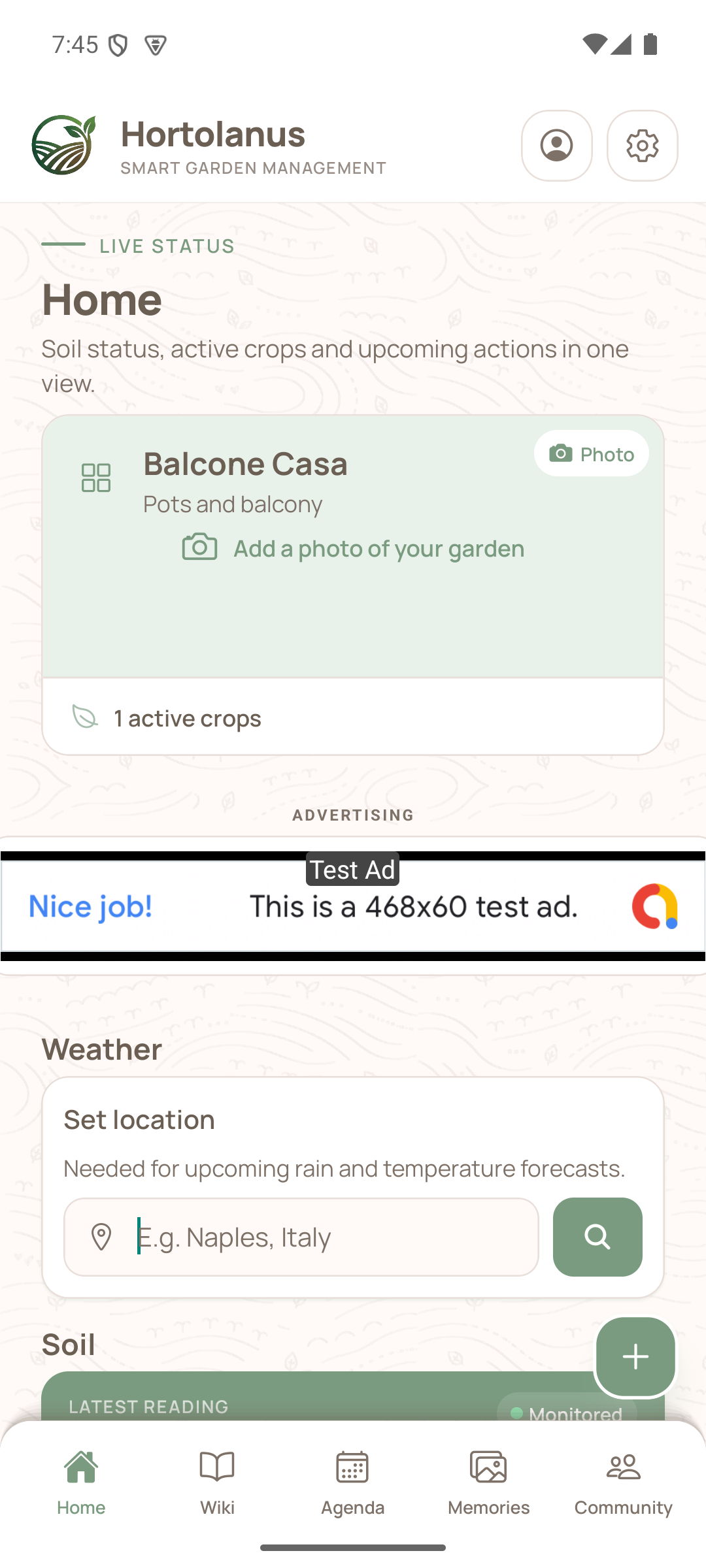
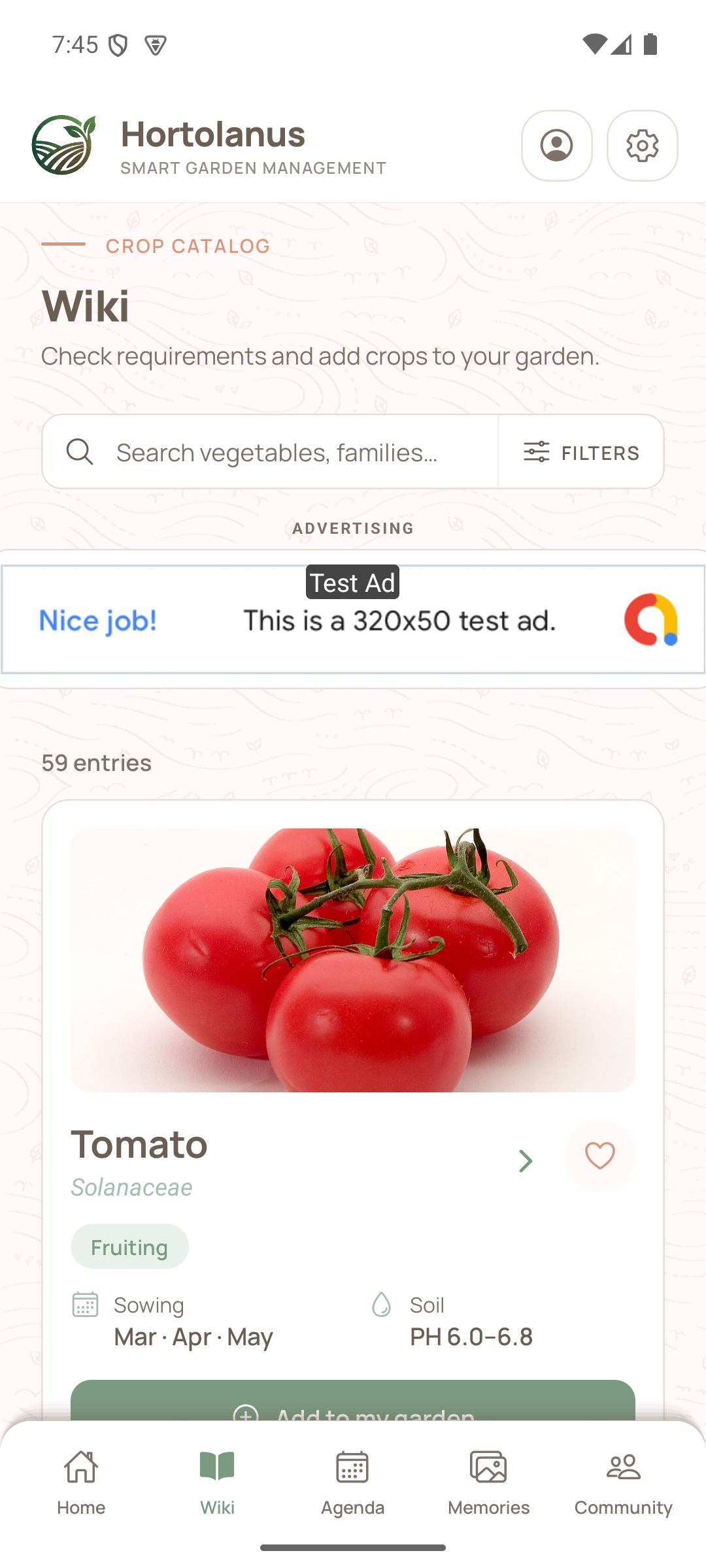
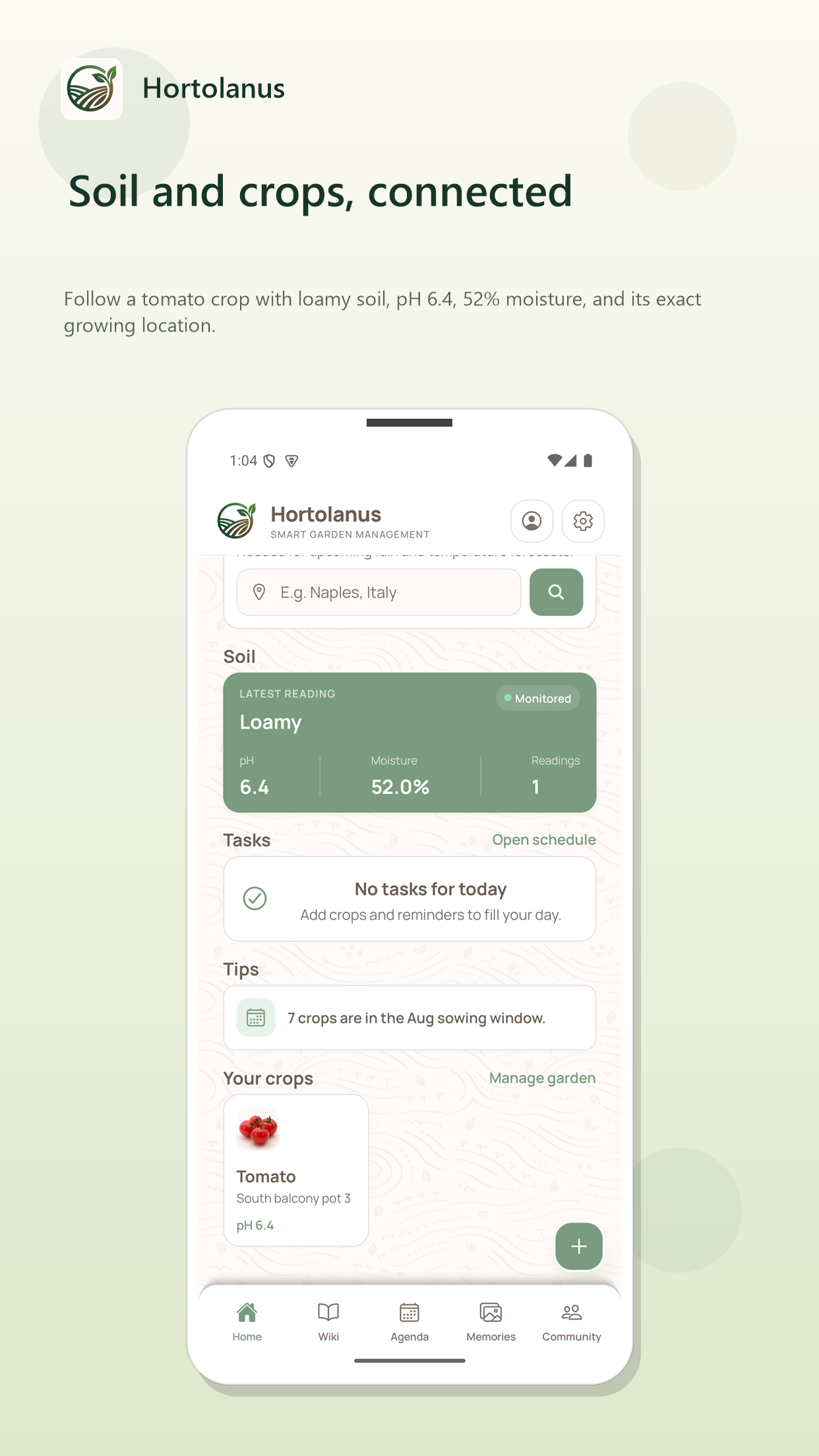
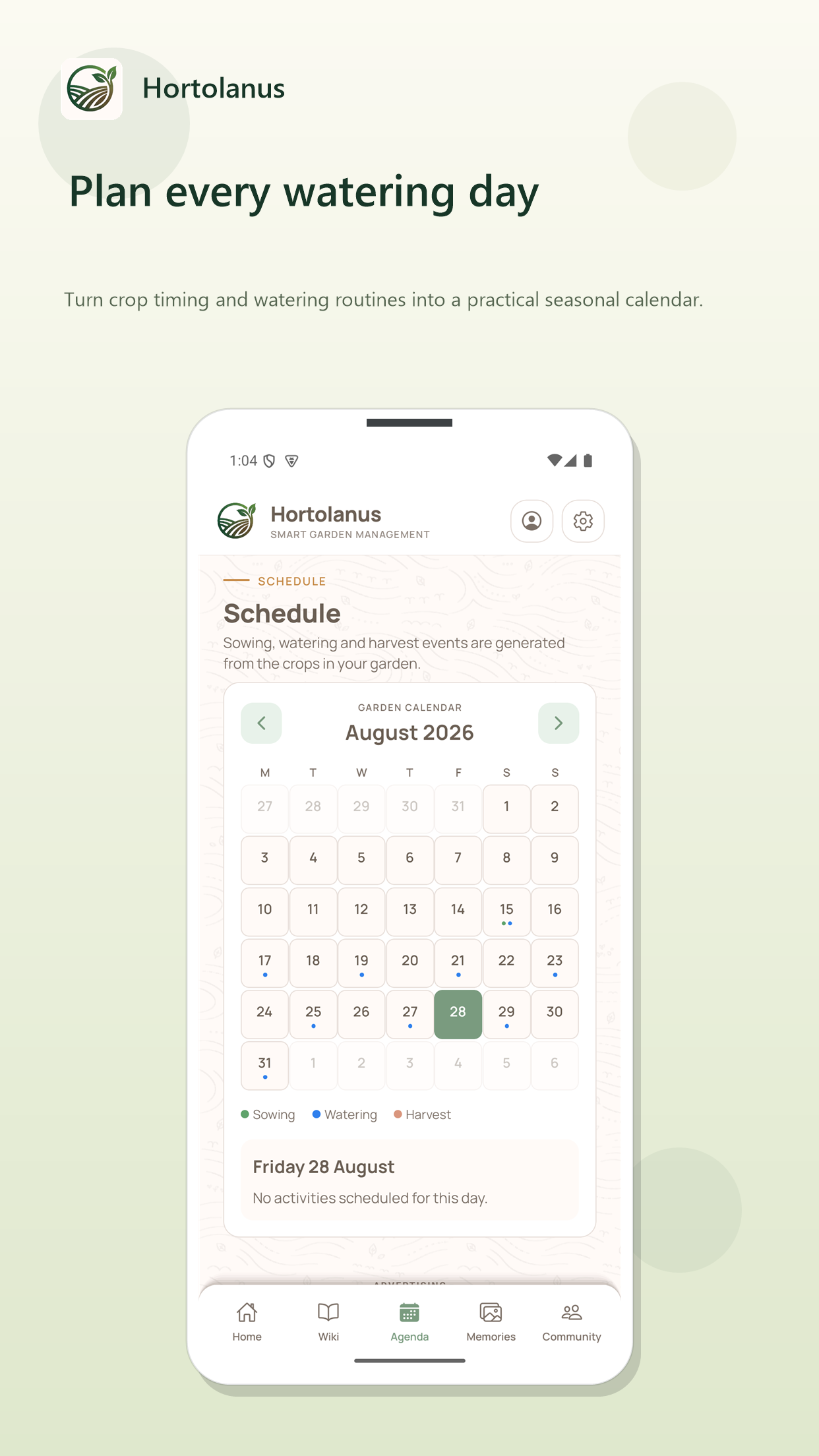
Hortolanus supports the vegetable garden across seasons, crops, and field work with an archive that stays easy to update.
What it actually includes
Hortolanus assists home gardeners with an offline encyclopedia of vegetables, a sowing and transplanting calendar, bed management, soil values, irrigation, companion planting, crop-family rotation, a diary, photos, and reminders.
Key features
It connects crops, garden areas, tasks, and observations season after season.
It helps decide what to do today and remember what worked before.
It is for people who want more method without turning the garden into paperwork.
Hortolanus
The topics this app helps you manage every day.
Tomatoes are frost-sensitive, so plant them outdoors only after your last spring frost date, once nighttime températures reliably stay above about 50°F (10°C). In most temperate climates this falls in mid-to-late spring; gardeners often start seeds indoors 6-8 weeks before that date and transplant seedlings out once they're hardened off. Exact timing shifts by several weeks depending on your climate zone, so always check local frost dates rather than a fixed calendar date. Hortolanus's offline vegetable encyclopedia gives sowing and transplanting windows for tomatoes and every other crop, right in your garden calendar.
Zucchini is even more cold-sensitive than tomatoes and needs soil that has warmed to at least 65°F (18°C). Wait until all frost risk has passed and nights stay reliably above roughly 55°F (13°C) before sowing seeds directly outdoors — zucchini grows fast and generally doesn't need to be started indoors. Many gardeners sow a second round in early summer for a fall harvest. Because these windows shift with climate and region, Hortolanus's vegetable encyclopedia gives sowing, transplanting, and harvest periods for zucchini and turns them into reminders in your own calendar.
A sowing calendar lists, month by month, which vegetables to sow, transplant, and harvest in a given climate. It exists because different crops germinate at different soil températures — cool-season vegetables like peas and spinach can go in early, while warm-season crops like squash and beans need to wait for warmer soil. Using one helps you avoid sowing too early (risking frost damage) or too late (missing the harvest window). Hortolanus turns this idea into a living tool: its offline encyclopedia's sowing and transplanting data for each vegetable populates your own calendar automatically.
Start seeds indoors 4-8 weeks before your last frost date for slow-growing or cold-sensitive crops like tomatoes, peppers, and eggplant, so they have a head start before the outdoor season begins. Fast-growing or root crops — zucchini, beans, carrots, radishes — generally do better sown directly outdoors since they dislike having their roots disturbed by transplanting. The right choice depends on the crop and your local growing season length. Each vegetable sheet in Hortolanus's offline encyclopedia specifies whether it prefers indoor starting or direct sowing, alongside its transplanting and harvest windows.
Sowing means placing a seed directly where it will germinate, either indoors in trays or outdoors in the garden bed. Transplanting means moving a seedling — started indoors or bought as a young plant — into its final growing spot once it's large enough and the weather allows. Some crops (carrots, beans, zucchini) resent transplanting and are best sown directly, while others (tomatoes, peppers, brassicas) are almost always transplanted as seedlings. Hortolanus's crop sheets specify both stages for each vegetable and link them to the specific garden area where you've planted them.
Harvest timing depends on the crop and what part of the plant you're eating: leafy greens are picked young for tenderness, root vegetables when they reach a usable size, and fruiting crops like tomatoes and zucchini when they reach full color and size but are still firm. Days-to-maturity listed on seed packets are a helpful guide but vary with weather and variety, so visual and tactile cues matter more than a fixed date. Hortolanus's offline encyclopedia lists expected harvest windows for each vegetable, so you always have a reference point alongside your own garden notes.
A good vegetable-growing app for beginners should cover the basics in one place: when to sow and transplant each crop, how much sun and water it needs, which plants grow well together, and a simple way to log what's happening in the garden over time. Look for something that works even without constant internet access, since a lot of gardening happens away from a good signal. Hortolanus is being built around exactly this: an offline encyclopedia of vegetables with sowing, transplanting, harvest, sun, water, and fertilizer info.
Good companions for tomatoes include basil, traditionally thought to help repel certain pests; carrots and onions, which use different root depths and don't compete heavily for space; and lettuce or spinach, which can grow in the shade tomato plants cast. Marigolds are also a popular companion for general pest deterrence. Avoid planting tomatoes near brassicas (cabbage, broccoli) or corn, which share pests and compete for nutrients. Hortolanus's companion planting feature lists recommended and discouraged pairings for tomatoes and every other crop in the encyclopedia, right where you're planning your beds.
A few pairings are consistently discouraged: beans and onions (onions can inhibit bean growth), carrots and dill (both from the same family, and dill can stunt carrots), and potatoes with tomatoes or peppers, since all three are nightshades that share pests and diseases. Vegetables from the same botanical family, in general, don't gain much from being planted side by side and are better kept apart or rotated over the years. Hortolanus flags these discouraged pairings directly on each crop sheet, alongside crop rotation warnings so you can catch conflicts before you plant.
Companion planting is the practice of growing certain plants near each other because of a believed benefit — pest deterrence, pollinator attraction, shade or support, or more efficient use of space. Some pairings, like tall corn supporting climbing beans, have a clear physical logic; others, like marigolds deterring nematodes, are backed by more mixed evidence but remain widely used low-risk practices. It's best treated as one useful tool among several, not a substitute for good soil, watering, and rotation practices. Hortolanus builds a list of recommended and discouraged companions into every crop sheet, so you can apply these principles without memorizing charts.
Crop rotation means avoiding planting the same vegetable, or others from its same family, in the same spot year after year. It matters because pests and diseases that target a specific crop can build up in soil where it's grown repeatedly, and different crops draw down different nutrients, so rotating helps keep soil fertility balanced. A common approach is a 3-4 year rotation, moving plant families to a new bed each season. Hortolanus's crop rotation warnings tell you when replanting a bed would repeat a recent family, so you can plan next season with last year's plantings in mind.
As a general rule, wait 3-4 years before growing the same vegetable, or a close relative from the same plant family, in the same bed. Heavy feeders like tomatoes and brassicas benefit most from a longer break, while light feeders like alliums can sometimes return sooner. The exact interval depends on which pests or diseases have affected that bed previously and how many separate growing areas you have available. Hortolanus keeps track of what you've grown in each garden area and warns you about rotation conflicts before you replant, so you don't have to remember years back on your own.
It's generally discouraged. Tomatoes and potatoes are both nightshades and susceptible to the same diseases, most notably early and late blight, so growing them close together — or in succession in the same soil — increases the risk of one infecting the other. If space allows, keep them in separate areas of the garden and avoid following one with the other in rotation. Hortolanus's companion planting data flags this kind of same-family conflict directly on the crop sheet, along with a crop rotation warning if you've grown one in that spot recently.
Vegetables are grouped into families based on shared botanical ancestry — for example nightshades (tomato, potato, pepper, eggplant), brassicas (cabbage, broccoli, kale), alliums (onion, garlic, leek), and cucurbits (zucchini, cucumber, melon). Members of the same family tend to share the same pests, diseases, and nutrient needs, which is exactly why crop rotation and companion planting are usually organized around family groups rather than individual vegetables. Hortolanus's companion planting and rotation warnings are built around these family relationships, so the guidance updates automatically as you plan what goes where.
Most vegetable gardens need roughly 1 inch (about 2.5 cm) of water per week, whether from rain or manual watering, which is enough to moisten the root zone to 6-8 inches deep. Hot weather, sandy soil, or containers all increase that requirement, while cooler weather or heavier clay soil reduce it. Deep, less frequent watering encourages stronger root systems than light daily sprinkling. Hortolanus lets you set configurable watering reminders for each crop, so the frequency can match what that specific vegetable and your conditions actually need.
Rather than watering on a fixed schedule, check the soil 1-2 inches below the surface — if it's dry at that depth, it's time to water. In practice this often works out to two or three deep waterings a week in warm weather, rather than daily light watering, which only wets the top layer and encourages shallow roots. Container plants typically need more frequent watering than in-ground beds. Hortolanus's watering reminders are configurable per crop, so you can tune them to match each vegetable's real needs instead of relying on a single generic schedule.
Most vegetables grow best in slightly acidic to neutral soil, roughly pH 6.0 to 6.8, where nutrients are most readily available to roots. Growth generally isn't seriously hindered between pH 5.5 and 7.5, though yields drop off outside that range, and a few crops like potatoes prefer the more acidic end. Because pH affects nutrient availability more than raw fertility, testing it is often more useful than adding more fertilizer. Hortolanus's soil value log lets you record pH readings for each garden area over time, alongside moisture and soil type notes.
You can use an inexpensive home pH test kit, test strips, or a soil probe meter — take samples from a few spots at root depth (not just the surface), mix them, and follow the kit's instructions. For a more precise reading, a local extension office or garden center can run a lab test. It's worth retesting once or twice a year, since pH can shift with fertilizing, rainfall, and amendments. Hortolanus's soil value log gives you a place to record pH results per garden area, so you can track how it changes season to season.
A simple way to check is the squeeze test: take a moist handful of soil and squeeze it. Sandy soil feels gritty and falls apart immediately; clay feels sticky and holds a tight ball; loam — the ideal mix — holds its shape loosely and crumbles when poked. A more precise version, the jar test, involves shaking soil with water in a jar and measuring the layers of sand, silt, and clay that settle out over 24 hours. Hortolanus's soil value log lets you record the soil type for each garden area alongside pH, moisture, and your own notes.
Blossom end rot — a dark, sunken patch on the bottom of the fruit — is caused by a local calcium shortage in the developing fruit, usually triggered by inconsistent watering rather than a true lack of calcium in the soil. Irregular watering, drought stress, and excess nitrogen fertilizer all interfere with how well the plant can move calcium to the fruit. Keeping soil moisture consistent is the most effective prevention. Hortolanus's configurable watering reminders help you keep watering intervals consistent per crop, which is one of the most effective ways to prevent this kind of calcium disruption.
Underwatered plants typically wilt, feel dry 1-2 inches below the soil surface, and have leaves that curl or feel crisp. Overwatered plants also wilt (because waterlogged roots can't take up oxygen) but the soil stays wet, leaves may turn yellow, and roots can begin to rot. Checking actual soil moisture, rather than the plant's appearance alone, is the most reliable way to tell them apart. Hortolanus's soil value log lets you record moisture readings for each garden area over time, so you can compare what you observed in the plant to what was actually happening in the soil.
Yellowing leaves can have several causes: nitrogen deficiency (usually starting with older, lower leaves), inconsistent watering, transplant shock in young plants, or pests like aphids and spider mites feeding on the underside of leaves. Fungal diseases such as early blight can also cause yellowing, usually combined with spots or a pattern moving up the plant. Because the cause matters for the fix, it helps to track when the yellowing started and what else changed. Hortolanus's diary lets you log symptoms with notes and photos over time, without needing an account, so you can compare what happened and when.
Aphids, slugs and snails, whiteflies, and various beetles (flea beetles, Japanese beetles, cucumber beetles) are among the most common vegetable garden pests. Low-impact controls include hand-picking, encouraging predators like ladybugs, spraying aphids off with water or a mild soap solution, and using beer traps or barriers for slugs. Consistent monitoring catches infestations early, when they're easiest to manage. Hortolanus's diary lets you log pest sightings and the treatments you tried, with photos, so you can see what worked the next time the same pest shows up.
Diseases (fungal, bacterial, or viral) tend to appear unevenly across a bed, worsen over days or weeks, and often show specific signs like spots, mold, or wilting on affected leaves. Nutrient deficiencies and other environmental disorders, by contrast, tend to appear more uniformly across a planting and correlate with something like recent weather, watering, or soil conditions. Photographing symptoms as they progress makes the pattern much easier to spot than relying on memory. Hortolanus's diary lets you record notes and photos of symptoms over time, making that kind of comparison easier.
A useful garden journal records what you planted and when, weather and watering patterns, pest or disease issues and how you handled them, and harvest results — reviewed over a season, these notes reveal patterns you'd otherwise forget, like which bed always struggles or which pest shows up every June. Consistency matters more than format: a quick note after each garden visit beats a detailed entry you never get around to writing. Hortolanus includes a diary for exactly this — interventions, notes, and photos — and it works without needing to create an account.
A paper notebook works fine for basic notes, but it's harder to search past entries, attach photos, or connect notes to a specific bed or crop over multiple seasons. An app becomes more useful once you're tracking several garden areas or want to look back at exactly when a problem started. Either way, what matters most is actually recording things consistently. Hortolanus's diary combines notes and photos with your garden record, and can be used without creating an account, so there's no signup barrier to just start logging.
Useful entries include sowing and transplanting dates, watering and fertilizing you've done, pest or disease sightings and how you treated them, weather extremes, and harvest amounts — plus photos, which often reveal changes you wouldn't otherwise notice week to week. Over a few seasons, this record becomes the best tool you have for improving your results, since it replaces guesswork with your own garden's actual history. Hortolanus's diary is built for exactly this: interventions, notes, and photos, usable without an account.
Many soil-borne diseases persist in the ground where an infected crop grew, so the most effective prevention is crop rotation — avoiding that vegetable, and its close relatives, in the same bed for 3-4 years. Removing infected plant debris at the end of the season, rather than composting it, also reduces carryover. Choosing disease-resistant varieties and keeping good airflow between plants helps further. Hortolanus's crop rotation warnings flag when you're about to replant a family that had problems in that garden area before, based on your own crop history.
Official store links are not available yet.
Link in preparationLink in preparation