
Features
It keeps tanks, water tests, maintenance, and observations in one readable archive.
- Dedicated profiles for each aquarium
- History of values and measurements
- Reminders for water changes, cleaning, and checks
Aquariums · Product
Clearer aquarium care, day after day.


Product
Aqualynx brings recurring tasks, water parameters, and observations into one place, helping aquariums be cared for with more continuity.
The experience is designed to reduce everyday complexity: readable information, useful reminders, and a history that restores the full picture without turning the hobby into paperwork.
Inside the app
Real app screens, updated as the product evolves.
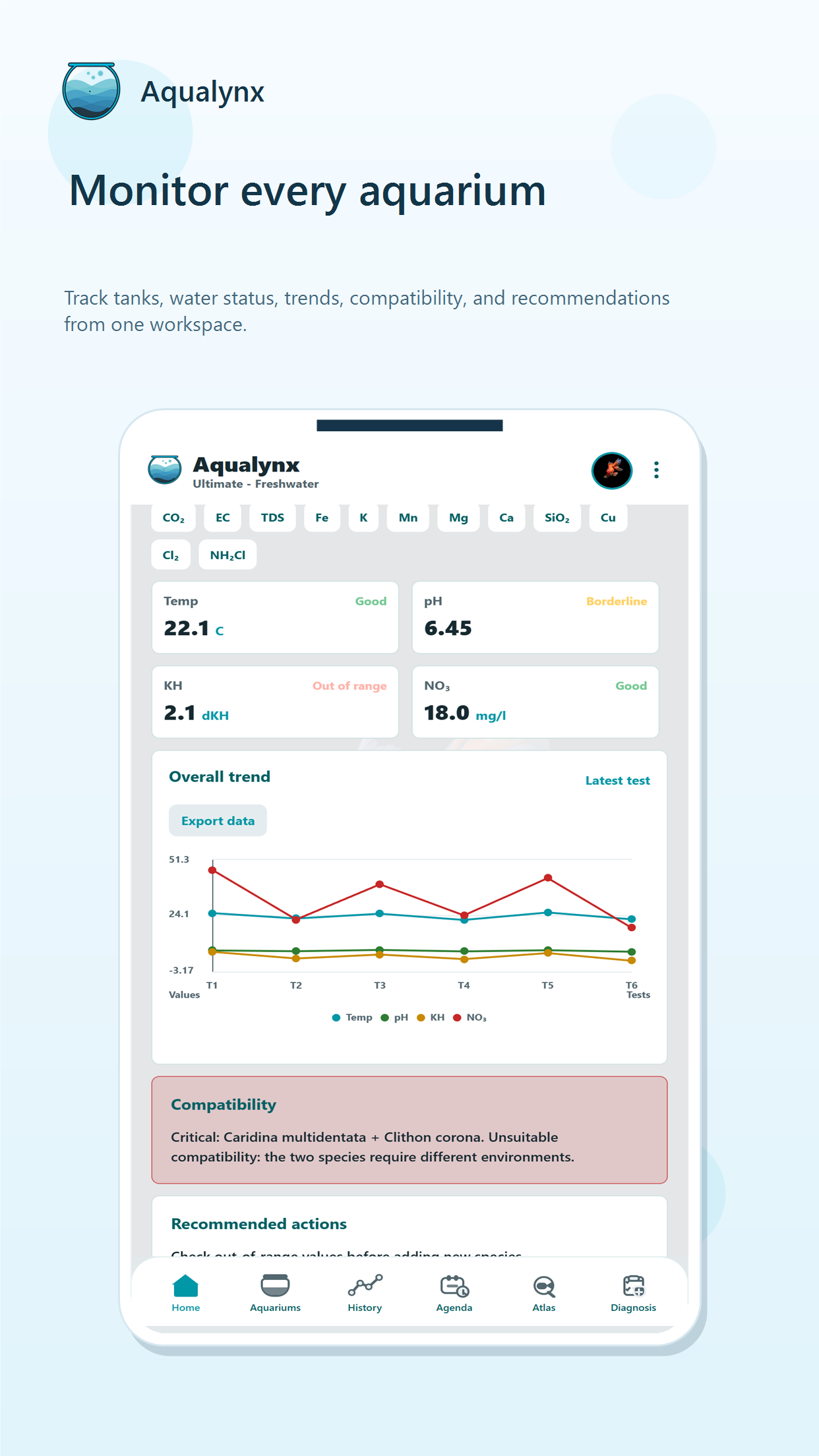
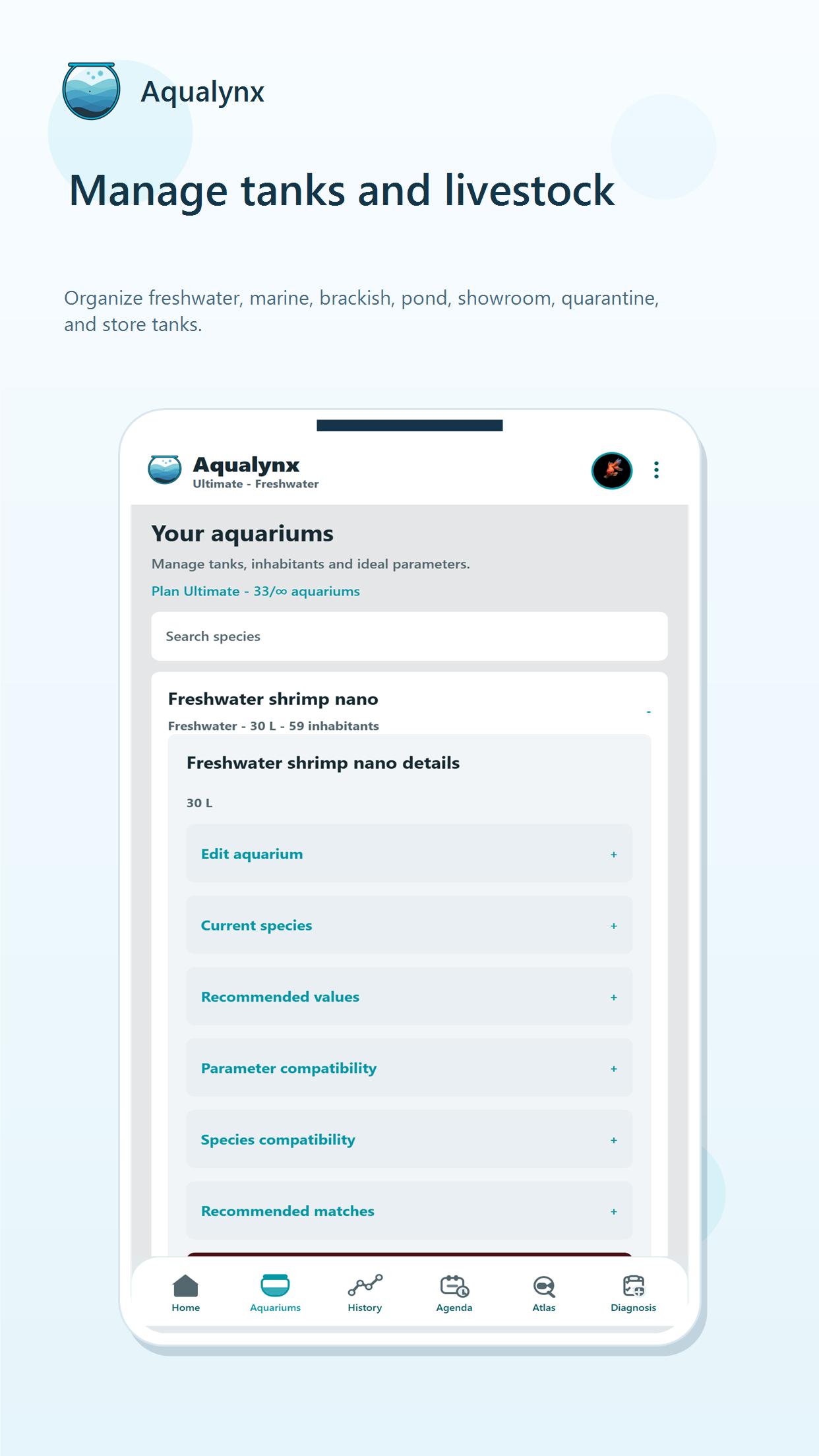
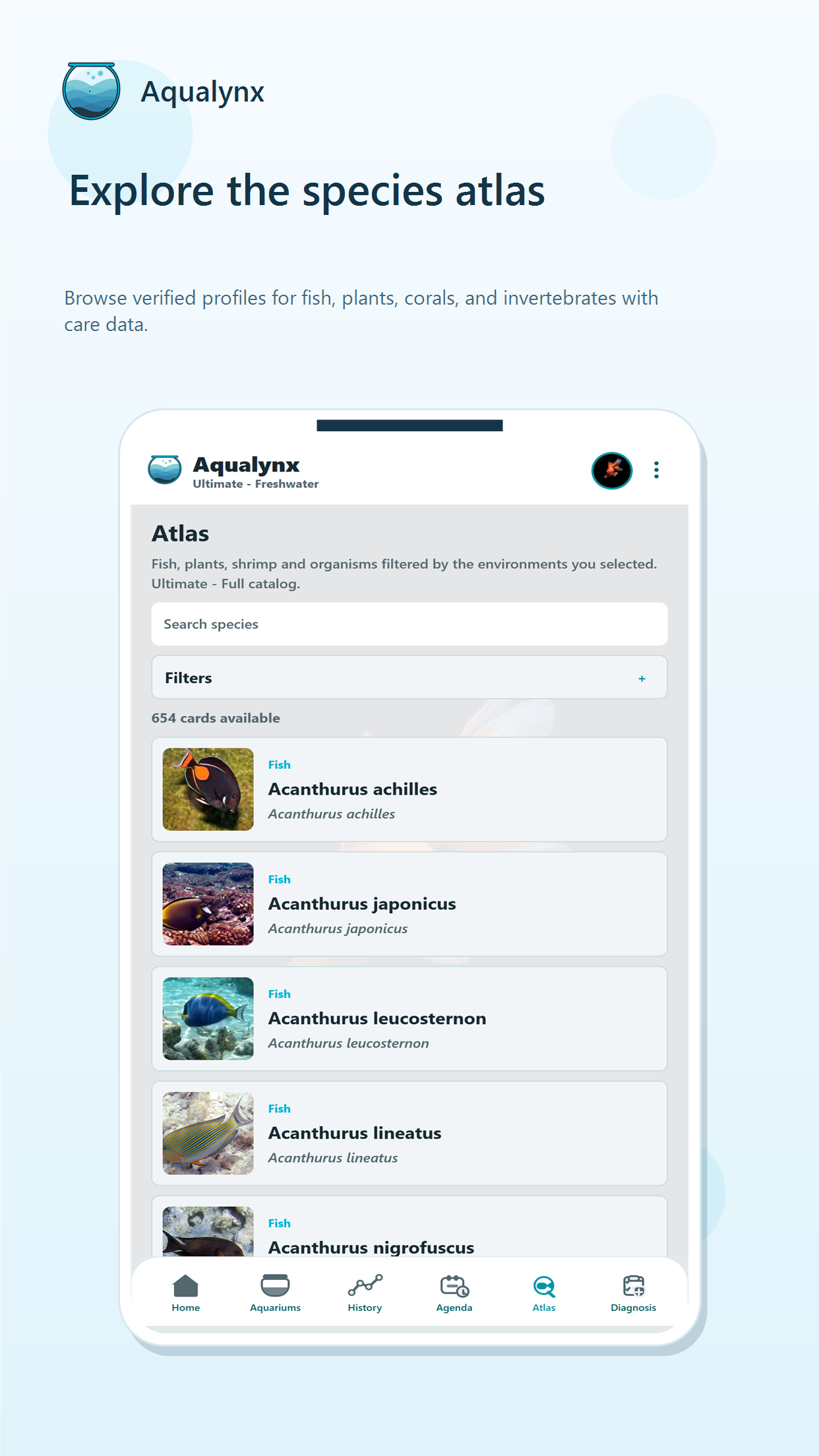
Aqualynx brings order to aquarium care: every tank gets its own diary, parameters, and reminders.
What it actually includes
Aqualynx organizes freshwater, marine, planted, or brackish tanks with a profile card for each aquarium, a history of test results, maintenance reminders, a species atlas, and a dedicated Diagnosis section for symptoms, algae, and recurring problems.
Key features
It keeps tanks, water tests, maintenance, and observations in one readable archive.
It turns scattered details into a clearer care routine.
It helps you understand what changed, what was already done, and what needs attention.
Aqualynx
The topics this app helps you manage every day.
Most healthy, moderately stocked freshwater tanks do well with a weekly water change of about 25-30% of the volume; heavily stocked tanks may need more frequent changes, while lightly stocked, well-planted tanks can sometimes stretch to every two weeks. The right frequency really depends on your tank's bioload, filtration, and how quickly waste builds up, so it's worth watching your fish and water clarity rather than following one fixed rule. Because it's easy to lose track of when the last change actually happened, Aqualynx lets you set recurring reminders for water changes so the schedule keeps running even when life gets busy.
As a general guideline, mechanical filter media (sponges, floss) benefits from a rinse every 2-4 weeks, while biological media should be cleaned more gently and less often, since it hosts the beneficial bacteria that keep ammonia and nitrite in check. Always rinse filter media in old tank water rather than tap water, and avoid cleaning everything at once so you don't wipe out your bacterial colony. To help you stay on a sustainable rhythm instead of over- or under-cleaning, Aqualynx includes recurring reminders you can set specifically for filter maintenance.
Cycling means growing a colony of beneficial bacteria that convert toxic ammonia into nitrite and then into much less harmful nitrate. In a fishless cycle, you add a small ammonia source, then test regularly until ammonia and nitrite both process down to zero, which usually takes several weeks. Watching how these values move over time is really the whole process, which is why Aqualynx keeps a full history of your water parameter readings so you can see the ammonia-to-nitrite-to-nitrate trend as your tank matures.
Weekly tasks usually include a partial water change, gravel vacuuming, wiping the glass, and a quick visual check on fish and plants; monthly tasks typically cover a deeper filter media rinse, checking equipment like heaters and pumps, and trimming or thinning plants. The exact split depends on your tank size and stocking, but having some kind of routine is what keeps small issues from turning into big ones. Aqualynx lets you set up recurring tasks on whatever cadence fits your tank, so weekly and monthly jobs don't get mixed up or forgotten.
Planted tanks can sometimes tolerate slightly less frequent water changes than a bare fish-only setup, since live plants absorb nitrate and other nutrients, but they still need regular changes to replenish trace elements and prevent algae-feeding nutrient buildup. Big swings in température or hardness during a water change can also stress sensitive plants, so consistency matters just as much as frequency. Because a planted tank has different needs than a fish-only or marine setup, Aqualynx lets you save your tank's environment type on its profile card, right alongside its volume and notes, so your care routine reflects the setup you actually have.
There's no single formula that works for every tank, since bioload depends on species size, temperament, filtration strength, and how heavily you feed, not just gallons of water. A commonly used freshwater rule of thumb, like one inch of adult fish per gallon, is a rough starting point at best, and it breaks down completely for larger or messier species. Because stocking decisións depend on knowing your specific tank's volume and current population, Aqualynx keeps a dedicated profile for each aquarium where you can track exactly what's already in there before adding anything new.
Most missed maintenance isn't down to laziness, it's simply that water changes, filter cleanings, and parameter checks don't happen on a schedule you naturally remember, especially across multiple tanks. Keeping a simple log of what you did and when, alongside your test results, makes it much easier to spot patterns, like nitrates creeping up because a water change slipped by two weeks. This is essentially why Aqualynx keeps a running history of your parameter readings and completed tasks in one place, so you get the full picture back instead of trying to recall it from memory.
Most community freshwater fish do fine somewhere between pH 6.5 and 7.5, and many are more adaptable than hobbyists assume, provided the pH is stable rather than swinging up and down. A sudden pH swing is usually more stressful to fish than a pH that's slightly outside the 'ideal' range but steady, so chasing a perfect number with chemicals can backfire if it causes instability. Aqualynx keeps a history of your pH readings over time, which makes it much easier to see whether your water is actually stable or fluctuating before you decide to intervene.
GH (general hardness) measures the calcium and magnesium dissolved in your water, which fish, plants, and invertebrates need for healthy growth, shell development, and molting. KH (carbonate hardness) is different, it measures the water's buffering capacity, essentially its ability to resist pH swings, so a low KH can mean an unstable pH even when everything else looks fine. Since these two values interact but aren't the same thing, Aqualynx logs GH and KH as part of your water parameter history so you can track both side by side over time.
In a healthy, cycled aquarium, ammonia should read essentially zero, because even small detectable amounts can burn fish gills, trigger excess mucus production, and stress their immune systems. The fastest way to bring a spike down is a sizeable partial water change, paired with cutting back on feeding until levels settle and checking that your filter's biological media is intact. Because ammonia problems are easiest to catch before they become serious, Aqualynx keeps a history of every parameter reading, so a rising trend shows up clearly rather than as a single alarming test result with no context.
Elevated nitrite is usually a sign of an incomplete or disrupted nitrogen cycle, often in a new tank or after aggressive filter cleaning. A large partial water change is the fastest way to bring levels down and give your fish some relief, and a conditioner that temporarily detoxifies nitrite can help while the bacterial colony re-establishes itself. Because nitrite spikes are much easier to catch early than to fix after the fact, Aqualynx's water parameter history lets you see exactly when nitrite started climbing so you can act before it becomes an emergency.
Nitrate is the end product of the nitrogen cycle, and it naturally accumulates over time from fish waste, uneaten food, and decaying plant matter. Unlike ammonia and nitrite, it isn't immediately toxic, but chronic high levels still stress fish and fuel algae growth. Regular partial water changes are the most reliable way to keep it in check, along with not overfeeding and keeping live plants that actually use nitrate as a nutrient. Since consistent water changes are the main defense here, Aqualynx's recurring reminders help make sure they actually happen on schedule instead of slipping for a few weeks at a time.
For an established, stable tank, testing every one to two weeks is generally enough, but a new tank that's still cycling needs much more frequent checks, sometimes daily, until ammonia and nitrite settle at zero. It's also worth testing right after any big change, like adding new fish, a large water change, or a filter clean, since that's when parameters are most likely to shift. Aqualynx lets you set recurring reminders for water testing so checks happen on a rhythm that matches your tank's actual stage, not just whenever you happen to remember.
Most reef and saltwater fish-only tanks are kept at a specific gravity around 1.024 to 1.026, close to natural seawater, though fish-only systems can sometimes run slightly lower. What matters most is consistency, since sudden salinity swings are far more stressful to fish and invertebrates than a value that's a little off but stable. Aqualynx tracks salinity as part of your water parameter history alongside pH, KH, GH, and température, so you can confirm your levels are holding steady over time rather than guessing.
Cloudy water usually falls into a few categories: a white, milky haze is often a bacterial bloom in a newly set up or recently disturbed tank, which typically clears on its own within a couple of weeks; fine dusty cloudiness is usually suspended particles from substrate or decorations; and green cloudiness points to a floating algae bloom, usually from too much light or excess nutrients. Cleaning up uneaten food and decaying debris, vacuuming substrate, and doing a partial water change addresses most cases, though it helps to know which type you're dealing with before you act. Aqualynx's guided diagnosis walks you through these different causes of cloudy water step by step, so you can figure out which one actually applies to your tank.
Black beard algae (BBA) is a tough, dark, bristly algae that tends to show up when CO2 levels are unstable, nutrients are out of balance, or maintenance has been inconsistent, so lasting removal really depends on fixing the underlying cause, not just scrubbing it away. In the short term, manually removing heavily affected leaves, scrubbing hard surfaces, and increasing water changes and circulation all help. Because BBA can look similar to other stubborn algae types at first glance, Aqualynx's guided diagnosis helps you confirm what you're actually dealing with before you commit to a treatment plan.
White spots that look like grains of salt scattered over the body, fins, or gills are a classic sign of ich (white spot disease), caused by a parasite that attaches to the fish's skin. It typically spreads through a tank quickly, especially after stress from température changes, transport, or overcrowding, and affected fish may flick against decorations or breathe rapidly as the parasite irritates their gills. This is a case where general advice can only go so far, so it's worth confirming the diagnosis and treatment approach with a vet or an experienced aquatics specialist rather than guessing. Aqualynx's guided diagnosis can help you narrow down whether the symptoms you're seeing match ich or another common issue before you decide on next steps.
Fin rot shows up as ragged, discolored, or eroding fin edges, and it's most often triggered by poor water quality, stress, or an injury that lets bacteria or fungus take hold on already-damaged tissue. Testing your water and correcting anything off, ammonia, nitrite, pH swings, is usually the first and most important step, since fin rot rarely improves if the underlying water conditions stay poor. Because ongoing or worsening cases can need more targeted treatment than water changes alone, it's a good idea to check in with a vet or aquatics specialist rather than self-medicating. Aqualynx's guided diagnosis for fish signals can help you connect what you're seeing to likely causes worth investigating first.
Green water is caused by a bloom of free-floating microscopic algae (phytoplankton), usually triggered by a combination of excess light and excess nutrients like nitrate and phosphate, rather than by anything dangerous on its own. Cutting back lighting duration, reducing nutrient input, adding fast-growing plants to compete for those nutrients, and in stubborn cases using a UV sterilizer are the most reliable fixes. Since green water and cloudy white or dusty water have different root causes and different fixes, Aqualynx's guided diagnosis helps you tell them apart instead of treating the wrong problem.
Yellowing leaves are one of the most common plant issues, and the pattern gives clues to the cause: older leaves yellowing first often points to nitrogen or magnesium deficiency, while new leaves turning pale with green veins usually signals an iron deficiency. Unstable CO2, too much or too little light, and inconsistent fertilizing can also produce yellowing that looks a lot like a nutrient problem even when it isn't. Because pinpointing the right cause matters before you start dosing fertilizers, Aqualynx's guided diagnosis for plant deficiencies walks through these symptom patterns to help you narrow it down.
Gasping at the surface almost always means a fish isn't getting enough oxygen, which can happen when water is too warm (warm water holds less oxygen), surface agitation is too low for proper gas exchange, or ammonia and nitrite are damaging the gills. Improving surface movement and aeration and testing your water immediately are the right first steps, since this can escalate quickly if oxygen stays low. If breathing doesn't improve once water quality and oxygenation are addressed, it's worth getting a vet or aquatics specialist involved rather than waiting it out. Aqualynx's guided diagnosis for fish signals is built to help you connect symptoms like this to the most likely causes so you know what to check first.
Compatible tank mates generally share similar water parameter needs (température, pH, hardness), similar temperaments, and a reasonable size difference so no one becomes a target or a predator. Peaceful schooling fish like many tetras, rasboras, and corydoras tend to mix well, while territorial or fin-nipping species can turn a calm tank into a stressful one even if the water parameters match perfectly. Because compatibility depends on more than just one factor, Aqualynx includes compatibility checks that weigh species, environment, and water parameter ranges together before you add something new.
Bettas can do well in a community setting if you choose calm, non-nippy species and give the tank enough space and cover, options like corydoras catfish, small peaceful tetras, and certain snails are commonly successful choices. What you want to avoid are fin-nippers and other bettas, since male bettas in particular are territorial and long fins are an easy target for nipping species. Aqualynx's compatibility checks are designed for exactly this kind of decisión, comparing a candidate species against your existing tank before you bring anything new home.
It's possible, but the honest answer is that no fish is completely guaranteed safe with shrimp, since if a fish's mouth is big enough to fit one, it eventually will. Smaller, peaceful species like ember tetras, chili rasboras, and otocinclus catfish are commonly kept successfully with adult shrimp, especially with plenty of plants and hiding spots, though even 'shrimp-safe' fish will often eat shrimp babies. Since this kind of pairing depends heavily on the specific species involved, Aqualynx's compatibility checks let you verify a potential tank mate against your shrimp and your tank's setup before adding it.
Java fern and Anubias are two of the most forgiving low-light plants, both can even be grown without substrate, attached instead to driftwood or rocks, and they tolerate a wide range of conditions. Other reliable low-tech options include Cryptocoryne wendtii, java moss, and Amazon sword, none of which need CO2 injection or intense lighting to thrive. Because picking the right plant for your specific setup makes a big difference in how easy it is to keep it alive, Aqualynx's atlas covers plants alongside fish and invertebrates, with the practical information you need to choose ones that fit your tank.
A quarantine period of at least two to four weeks is a widely recommended minimum, since that's roughly how long it takes for parasites or diseases to show visible symptoms, and some hobbyists extend it to six weeks or more for extra safety with sensitive livestock. Keeping new arrivals separate protects your entire established tank from a single sick or stressed fish, which is far easier than treating an outbreak after the fact. Before you even get to quarantine, it helps to know what a species actually needs, which is exactly what Aqualynx's atlas of fish, plants, and invertebrates is there for, giving you that information before the animal comes home.
Mystery snails are generally considered a beneficial addition rather than a pest, they clean up algae, leftover food, and decaying plant matter, and unlike some snail species, they don't eat healthy live plants. Their eggs are also easy to manage, since mystery snails lay visible clutches above the waterline that you can simply remove, unlike pest snails that multiply out of control in the substrate. They do produce a fair amount of waste for their size, so they're best suited to tanks of at least 15 gallons or so. Aqualynx's atlas includes invertebrates like snails alongside fish and plants, with the kind of practical info that helps you tell a helpful addition from a genuine pest before you buy one.
A brackish aquarium sits between freshwater and full saltwater, typically with a specific gravity between about 1.005 and 1.010, and it needs equipment rated for saltwater use since salt is corrosive to standard freshwater gear over time. Like any new tank, it needs to be fully cycled before fish go in, and salinity should be tested regularly with a hydrometer or refractometer rather than assumed. Because brackish setups have different needs than a standard freshwater or marine tank, Aqualynx lets you specify your aquarium's environment type right on its profile card, so the rest of your tracking reflects the tank you actually have.
Download the app from the official stores available below.